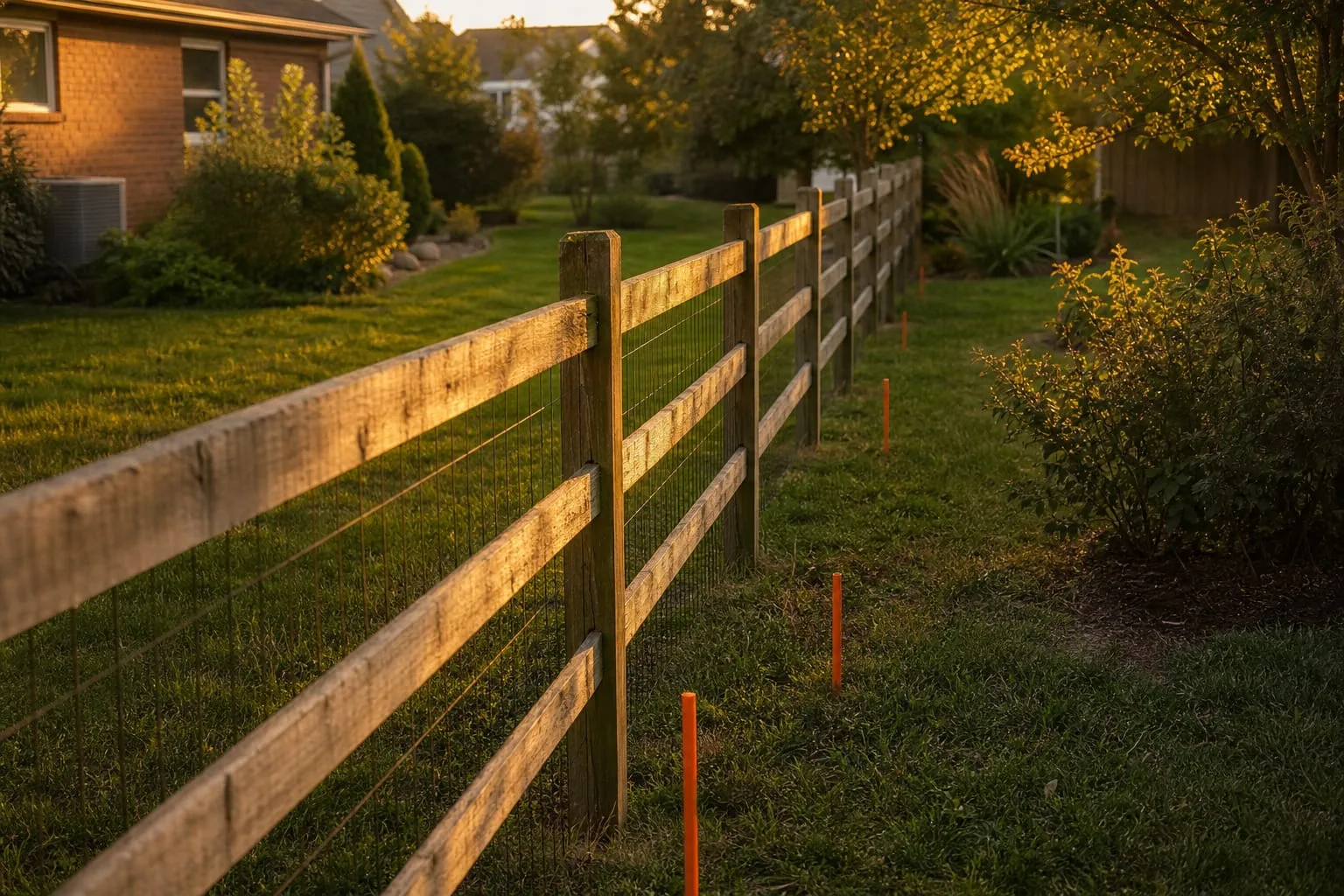
A replacement fence went up along a suburban side yard in April, and by the middle of May the neighbor had measured it and concluded that about sixty feet of it sat six inches onto their land. Neither household wanted a fight and both spent the following four months in one anyway, in the mild, exhausting way these things proceed. What makes the case worth walking through is not the outcome, which was unremarkable, but the distribution of effort: nearly all of the work required no attorney at all, and one narrow piece of it absolutely did.
What the Survey Settled, and What It Did Not
The first move both sides agreed on was a survey, which cost a few hundred dollars split between them and which they expected to end the matter. It established the boundary and confirmed that the fence sat over it by roughly the distance the neighbor had measured. That was genuinely useful and it resolved the factual question completely, which is more than most disputes ever achieve, and it did so for a fraction of what either household would later spend on the argument that followed. Surveys are among the few purchases in a boundary dispute that reliably return more than they cost.
What a survey cannot do is say what follows from the fact, and this is where the households diverged. One assumed that a fence over a line must obviously come down. The other assumed that six inches was trivial and that a payment or an apology would close it. Both positions were reasonable and neither was legally determinative, because the answer depends on state law, on how long the line had been treated as the boundary, and on what either party had said or done in the years beforehand. The survey narrowed the argument without deciding it.
The Letter That Needed No Attorney
Six weeks in, with conversations going in circles, the fence owner wrote a letter, and it did more than anything else in the four months. It was a page long, it stated the facts in order with dates, it attached the survey, and it made a specific offer: move the fence at the owner's expense within sixty days, or leave it and record a written acknowledgment that the boundary remained where the survey put it. It named a date for a reply. Nothing in it asked the neighbor to agree that anybody had behaved badly, which is the omission that made it possible to reply to at all.
Nothing in that letter required legal training and everything in it required discipline. It contained no adjectives about the neighbor, no history of the driveway dispute from four years earlier, and no threats. What it did contain was a choice, which converted an argument about who was being unreasonable into a decision with two options and a deadline. The reply came in eleven days, and it was the first communication in the whole matter that engaged with what would actually happen next.
Where an Attorney Became Genuinely Worth It
The neighbor accepted the second option, and that is exactly the point at which a household should stop improvising. An agreement that a fence may remain on somebody else's land without changing where the boundary sits is a document with long consequences: it has to be written so that permission does not ripen into a claim, so that it binds whoever buys either house, and so that a title company reading it in fifteen years understands what it does. Any of those three handled loosely turns a settled matter back into an open one at the point of a sale, which is the least convenient moment available.
An hour with a real estate attorney produced that document. The advice included two things neither household had considered, that the agreement should be recorded rather than merely signed, and that it should state plainly that the permission was revocable and personal rather than permanent. Both points are ordinary practice and neither would have occurred to a careful layperson working from general reading, which is precisely the definition of the work worth paying for. An attorney who does this weekly knows the two failure modes without having to look them up, and that knowledge is what the hour actually purchases.
What the Hour Actually Bought
The fee was modest, comparable to the survey, and it bought three things that were not otherwise available. The first was the language, which is a craft. The second was a document that a future buyer's attorney would recognize and accept, rather than a handwritten agreement that would raise a question at the worst possible moment during a sale. The third was an end, because a signed and recorded instrument closes a matter in a way that a friendly understanding between two neighbors does not. Recording it also means neither household has to remember where the paper is in twelve years, which is the practical reason recording exists at all.
Weighed against four months of accumulated aggravation, that hour was the cheapest part of the entire episode, and both households said afterward that they wished it had come earlier. What they meant was not that they wished they had hired attorneys in May. It was that they wished somebody had told them in May which single hour was worth buying, since the instinct in a dispute is either to hire nobody at all or to hand the whole thing over. The middle option, buying an hour on one specific question, is the one nobody suggests, and it is almost always the right amount of professional help for a dispute this size.
What Both Sides Would Do Differently
The fence owner would have surveyed before building rather than relying on an old line of shrubs, which is the entire lesson in one sentence and costs a fraction of a fence. The neighbor would have raised it in the first week rather than the fourth, when the posts were set in concrete and any solution had become expensive. Both would have put things in writing sooner, since the only communications that moved the matter forward were the written ones. Every verbal exchange across four months produced a different recollection on each side, and every written one produced a response within a fortnight.
The shape of this dispute is common enough to generalize. Facts get established cheaply, positions get exchanged for free, and the moment something needs to be durable is the moment to buy an hour of expertise rather than a representative. Six inches of suburban side yard is not worth four months of anybody's summer, and the households that avoid that particular summer are not the ones who know property law. They are the ones who write things down early and know which single question they cannot answer themselves.