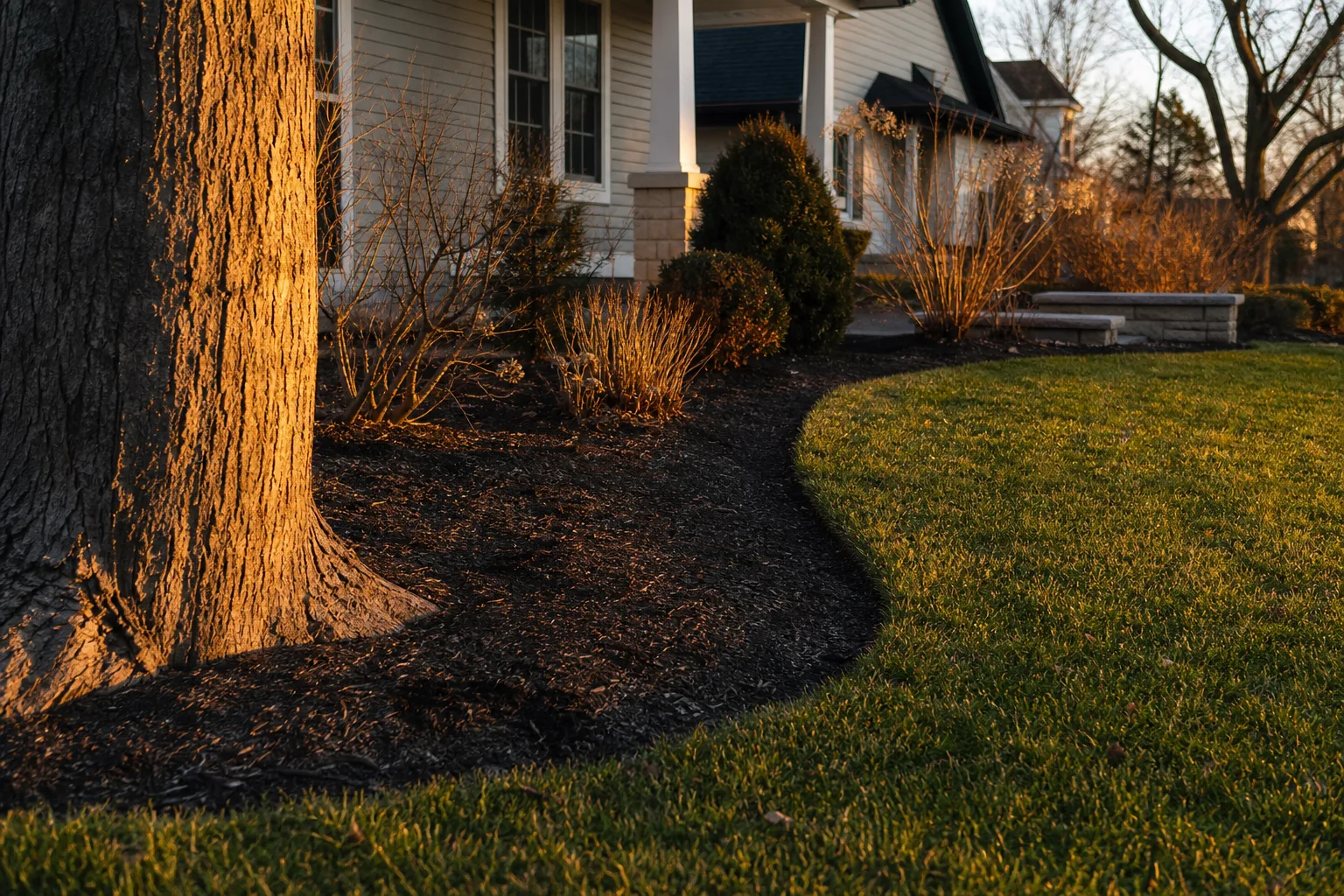
The install is the number everyone remembers. Eleven thousand dollars for the beds, the trees, the stone edging, the irrigation zones. It gets discussed, compared, financed. Then the landscape moves onto a monthly line item and nobody looks at it again for four years, by which point the quality of that line item has decided whether the eleven thousand still exists in any meaningful form.
I have priced maintenance on small residential lots and on portfolios of forty properties under one contract, and the thing that surprises people most is how little the monthly price tells you. Two crews will quote within fifteen dollars of each other for the same yard. One of them is selling you a mowing pass. The other is selling you the condition of the property in year three. Same invoice, different product.
What a crew is actually doing with the time on site
Start with duration, because duration is the honest variable. A quarter-acre lot with beds, a few small trees and a strip of turf takes a two-person crew somewhere between twenty-five minutes and a little over an hour, depending entirely on what is included.
The short version is mow, string trim the edges, blow the hard surfaces, leave. Nothing in that sequence touches a bed. Nothing checks an irrigation head. Nobody looks up at a tree. It is a visual reset of the lawn and the driveway, and for some properties that is all that is wanted, honestly priced.
The longer version adds things that do not show up the day they are done. Hand-pulling weeds out of bed interiors rather than only the visible front edge. Cutting the bed line back to the original shape instead of letting turf creep in an inch a season. Pulling mulch back off tree flares. Checking that a spray head has not been knocked sideways by a mower and is watering the sidewalk. Adjusting mowing height by season instead of running the deck at one setting all year.
None of that is exotic. All of it takes minutes. The reason it gets dropped is that it costs labor now and pays off later, and the person paying the invoice usually cannot tell the difference at the time.
Where the gap shows up, and when
The difference between a good maintenance job and a barely adequate one is invisible in month one, arguable in year one, and unmistakable in year three. The failures are slow and they are all the same kind of failure: something that was supposed to be held in place drifts.
Bed lines drift. Turf advances into planting beds a small amount each season and beds lose their geometry. Restoring them later is a cutting and hauling job, not a trimming job.
Mulch depth drifts. A crew that adds two fresh inches every spring without removing anything builds a rising shelf against the trunks of shrubs and small trees. Six years of that buries the root flare, holds moisture against bark, and kills things that were expensive to plant. The fix is a shovel and half an hour, done on time. Done late, it is a replacement tree.
Irrigation drifts. Heads get clipped, tilted, blocked by the very shrubs they were installed to water. A zone that has been spraying a fence for two seasons still shows up on the water bill every time it runs. The Environmental Protection Agency is the federal body responsible for water efficiency labeling on irrigation equipment, and the reason a labeled controller is worth anything is that somebody is checking whether the heads under it still point where they were aimed.
Pruning drifts worst of all. Shearing a shrub into a ball is fast and it looks tidy the same afternoon. Do it for five years and you have a hollow shell with all its growth on the outer two inches and bare wood underneath. Selective pruning takes longer per plant, looks marginally less crisp on day one, and leaves you with a shrub that can be kept at that size indefinitely.
Why the same work costs a company something different than it costs you
Here is where household math and company math genuinely separate, and it is worth understanding before you try to negotiate.
A landscape company does not price your yard. It prices your yard's position on a route. The crew has a truck, a trailer, fuel, a drive time between stops, and a fixed number of productive hours in a day. A property that sits between two others they already service is close to free to add. The same property standing alone, twenty minutes off the route, carries the full cost of the detour whether the visit takes thirty minutes or ninety.
That is why identical lots on opposite sides of town come back with different numbers, and why a neighbor's price is not a useful benchmark unless the neighbor is literally next door. It is also why the cheapest quote you get is often from whoever is already working on your street. That is not a discount you talked them into. It is real economics and you should take it.
The volume side works the other way on quality. A company running forty properties can afford a dedicated irrigation tech, a licensed applicator for anything that requires one, and a supervisor who walks sites without a mower in his hands. A two-person operation cannot carry those roles, so the same skills have to live in the two people on the truck. Both models produce excellent work. They fail differently. The big operation fails by sending an unsupervised crew that treats every property as the same property. The small operation fails when the one person who knows what he is doing is stretched over too many stops.
How to read a maintenance quote so the difference is visible
Ask for the visit count by month, not by year. Thirty-two visits sounds like a lot until you see that twenty-six of them fall between April and September and the property goes untouched from November to March, which is exactly when dormant pruning and bed edging should happen.
Ask what is included versus billed separately. Mulch, spring and fall cleanups, pruning, irrigation startup and winterization, fertilization, and leaf removal are the six items most often carved out. A low monthly number with all six carved out is not a low number.
Ask who is on the truck and whether the same crew returns. Continuity is the single best predictor of whether anyone notices the small drifts before they become large ones. A crew that has seen your beds eighteen times knows what changed. A rotating crew does not.
Ask what they will tell you about. The maintenance relationships that hold up are the ones where somebody sends a note in July saying zone four is not reaching the far corner. That note is worth more than the mowing.
Then look at the property in February, with everything dormant and nothing hiding the structure. The bed lines, the mulch depth, the shape of the shrubs and the flare of the trunks are all visible in a way they never are in June. Whatever the maintenance has been buying you for the past year is sitting right there in plain sight, and it is the only inspection that costs nothing.