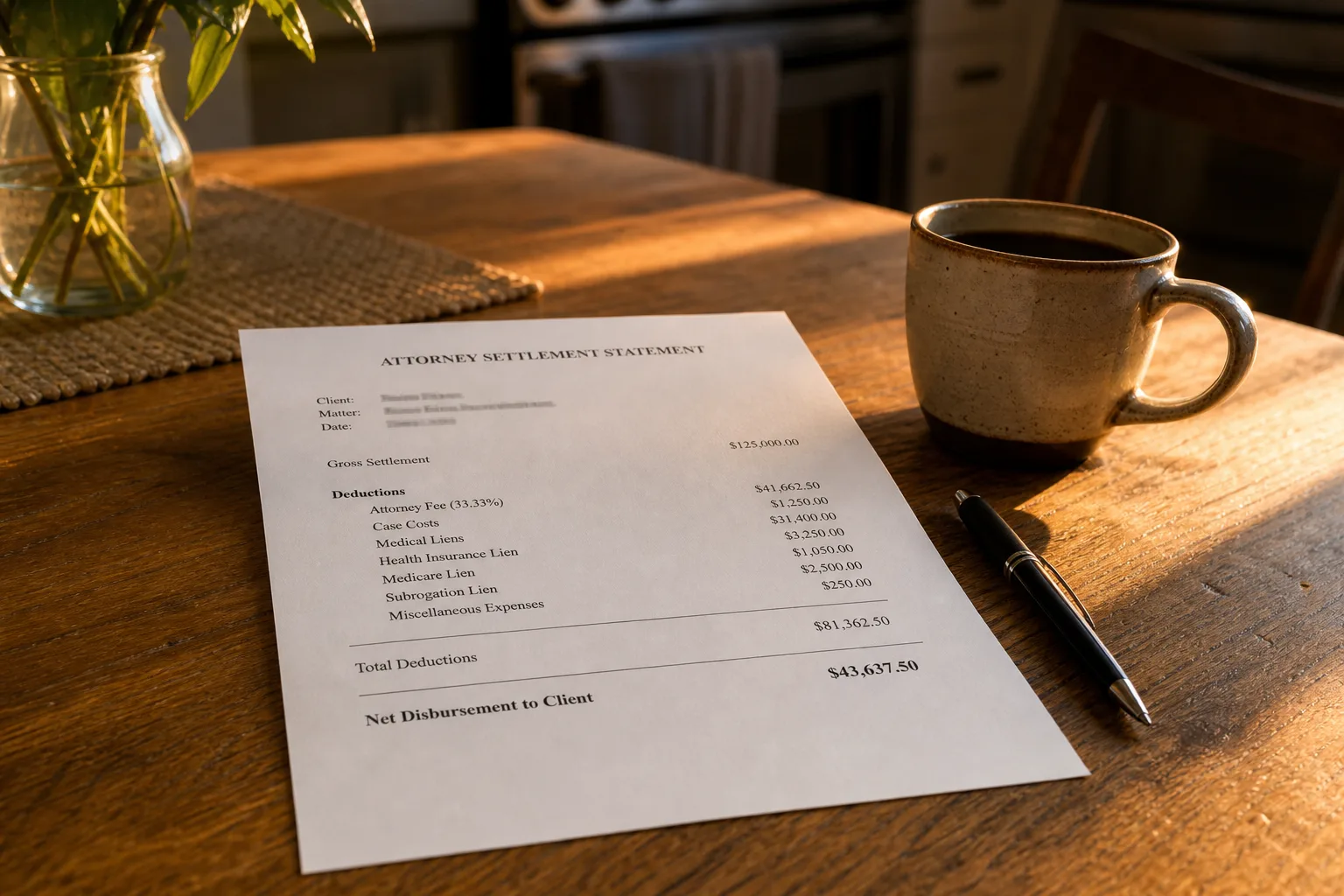
A percentage is half a price. The other half is what the percentage is multiplied by, and almost nobody asks about it the first time they hire a lawyer. Two firms can both say one third. One of them means a third of everything the insurer pays. The other means a third of what is left after the case expenses come out. On a modest injury claim that difference can run to a few thousand dollars, and it shows up only once, at the end, on a single sheet of paper called a settlement statement.
The rate gets negotiated. The base rarely does, because most people do not know it exists as a separate thing.
Gross recovery and net recovery are two different numbers
In a contingency arrangement, the lawyer is paid a share of what you recover and nothing if you recover nothing. The fee agreement will say the share. It will also say, somewhere further down, whether that share is calculated on the gross recovery (the full amount paid out) or the net recovery (the full amount minus the costs of running the case).
Costs are not the fee. Costs are the out-of-pocket spending: filing fees, the court reporter for a deposition, the charge a hospital makes for producing your records, postage, an accident reconstruction expert if the case needs one. On a straightforward rear-end collision that might be a few hundred dollars. On a disputed liability case with two experts and a set of depositions, it can be a serious number.
Say a case settles for $60,000 with $6,000 in costs. A third of gross is $20,000, and you net $34,000 before any medical liens. A third of net is $18,000, and you net $36,000. Same percentage. Same case. Two thousand dollars of difference created entirely by the order of operations. Neither approach is improper, and plenty of good firms use the gross method openly and explain it. The problem is not the method. The problem is finding out about it in month eleven.
The questions that get you the base
You do not need to read the agreement like a lawyer. You need four answers, in writing, before you sign.
- Is the fee calculated before or after case costs come out? Ask it in exactly those words.
- Does the percentage change, and when? Many agreements step up if a lawsuit is filed, and step up again if the case goes to trial or appeal. A quote of one third may be one third today and forty percent the day a petition is filed.
- If we lose, do I owe the costs? Some firms absorb them. Some advance them and expect repayment. Both exist.
- Who handles medical liens and unpaid bills, and is the fee taken before or after they are paid? Liens come out of your share, not the lawyer's, in most structures. This is where first-timers are most often surprised.
That last one deserves a sentence of its own. Health insurers, hospitals and government programs can have a claim on your settlement. A firm that works those numbers down before disbursing is doing real, unglamorous work that changes what you actually keep, and it is fair to ask how that is handled. When you are comparing one personal injury lawyer in oklahoma against another, the answers to these four questions tell you more than the headline percentage does.
Hourly work: the unit is part of the quote
Outside of injury cases, most legal work is billed by time, and the same problem appears in a different costume. The rate is quoted. The base is the billing increment: the smallest slice of time the firm records. A firm billing in tenths of an hour charges six minutes for a two-minute phone call. A firm billing in quarter hours charges fifteen.
Over a contained matter, a will or a single contract review, that gap is small. Over a year of a landlord dispute with frequent short emails, it compounds quietly. Twenty short calls at a quarter hour apiece is five billed hours. The same twenty calls in tenths is two.
The other half of the base is who is doing the work. A senior partner's rate applied to document review costs more than a paralegal's rate applied to the same task, and a well-run firm will tell you upfront which tasks get pushed down to lower-billing staff. Ask for the rate sheet, not the rate.
A flat fee is a fee for a defined scope, and the scope is the base
Flat fees feel like the safe option because there is a single number. The number is only as fixed as the description attached to it. An uncontested matter quoted flat becomes an hourly matter the moment someone contests it. A business formation package quoted at one price covers the documents named in the engagement letter and nothing else.
Read the sentence that starts "this fee includes" and then look for the one that starts "the following are not included." That second sentence is the base. If it is missing, ask for it to be written in.
Why a company gets a different answer than a household
A household hires a lawyer once or twice in a lifetime. There is no second case to bargain with, no volume to offer, no track record of paying invoices on time. So the household takes the standard agreement, and the standard agreement is drafted by the firm.
A company with a steady flow of matters negotiates the base rather than the rate. It sets caps on costs above a threshold, requires approval before an expert is retained, specifies billing in tenths, names which staff level handles which task, and asks for monthly detail rather than a lump sum at the end. None of that is unavailable to an individual. It is simply never offered, because the firm has no reason to offer terms nobody asks for.
The single move that closes most of that gap is asking for a worked example. Give the lawyer a plausible settlement figure and a plausible cost figure and ask what your check looks like. A firm that runs the arithmetic in front of you is telling you the base without you having to decipher it. And if you do end up with a settlement, remember that the tax treatment of the proceeds is a separate question with its own rules: the Internal Revenue Service is responsible for how different categories of settlement money are treated on a return, and it is worth raising before the money moves, not after.
The fee agreement is usually signed in the first meeting, when the case is abstract and the money is hypothetical. That is the one moment when the base is still open to discussion. Ten minutes and four questions there decide a number you will not see for another year.