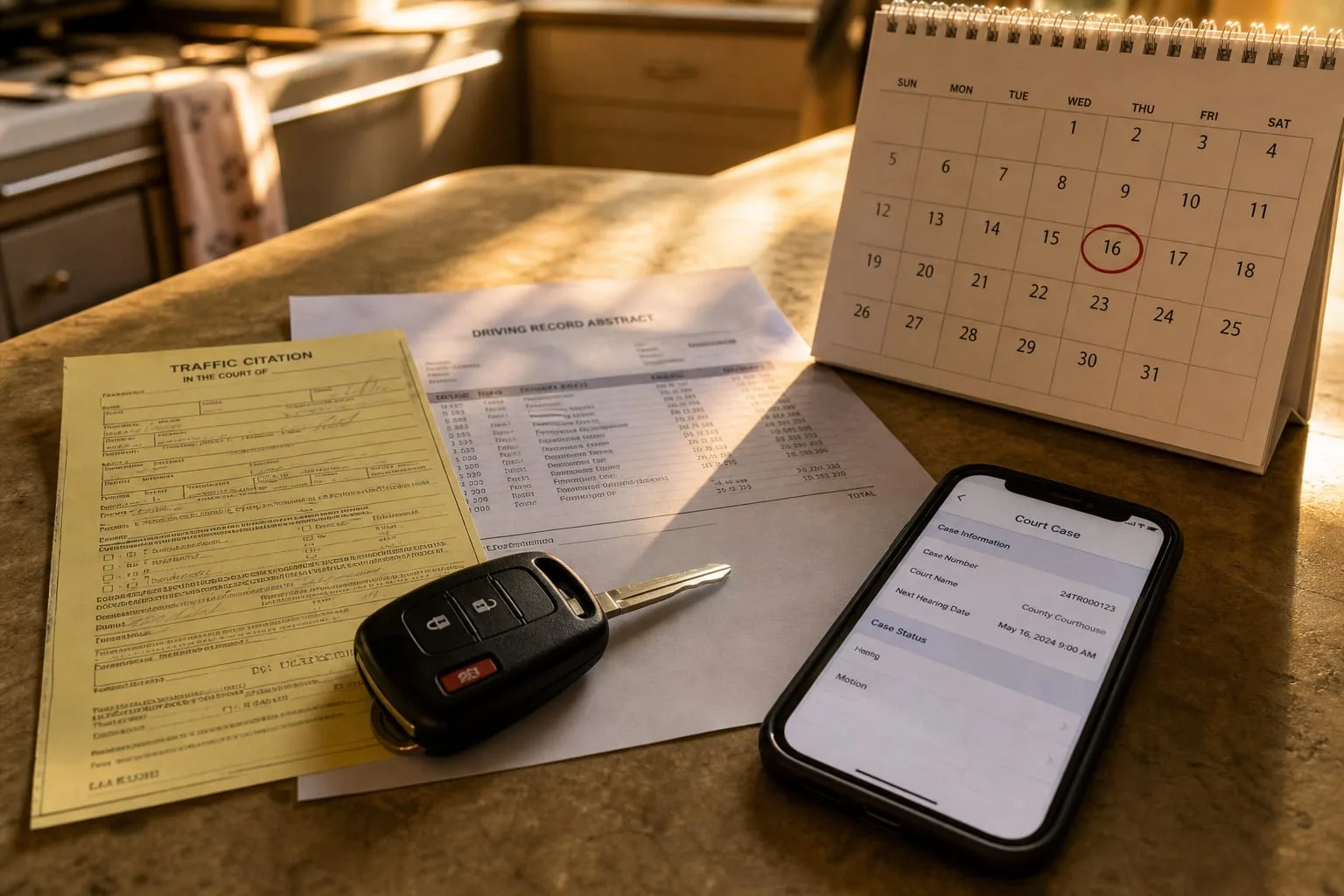
A traffic citation used to sit still for a while. An officer wrote it on a pad, tore off your copy, and the court's copy traveled by interoffice mail and got keyed in by a clerk sometime that month. You had a window that felt generous because the system was slow at both ends. That window is mostly gone. Citations are issued from a device in the patrol car now, uploaded the same shift, and matched to your license number before you have finished telling anyone at home about it. The deadline on the paper still says what it says, but everything behind it moves faster, which changes what a first meeting with an attorney needs to accomplish.
The practical consequence is that the first meeting is no longer for discovery. Ten years ago you showed up with a ticket and the attorney explained how the process worked, because you had no way of knowing. Now the court's portal has already told you the hearing type, the case number, and possibly the assigned judge. What you cannot get from a portal is a judgment about which of the available paths is worth taking, and that judgment depends entirely on facts you have to bring with you. Five of them do most of the work.
1. The citation itself, and the exact date the clock started
Bring the physical ticket, or the emailed version, or a photograph of it. Not a summary. The paper carries several numbers that look interchangeable and are not: the citation number, the case or cause number the court assigns later, the officer's badge number, and the statute or municipal code section you are alleged to have violated. That last one matters more than people expect, because two tickets that sound identical in conversation can sit under different code sections with different consequences on a driving record.
Then find the response deadline and note what event it runs from. On most citations it runs from the date of issue, not from the date you received anything in the mail, and not from the date the court's website first showed your case. That distinction used to be theoretical when everything moved slowly. It is not theoretical now. A response window that expires quietly can convert a contestable ticket into a committed finding, and the fix afterward is a motion rather than a hearing, which costs more and works less often.
If you have already done something with the ticket, say so at the start. Paid part of it. Clicked a button on a portal to request a hearing. Mailed the tear-off slip. Each of those is an act with legal meaning, and the attorney's advice changes depending on which ones you have performed.
2. Your actual driving record, not your memory of it
Almost nobody remembers their record accurately. People forget a citation from four years ago in another county, or they remember taking a class and assume the underlying ticket vanished when it did not, or they misremember a deferral as a dismissal. A deferral is an arrangement where the court holds the ticket open and dismisses it if you stay clean for a set period, and in most places you only get one every few years. If you used yours in 2021 and do not recall it, you will walk into the meeting expecting an option that is not available.
Ordering the record from the DMV is a same-week errand now and it was a mail-in form ten years ago. That is the single biggest change in what a client can bring to a first meeting. Pull the abstract, print it, and hand it over. The attorney reads it for prior dispositions, for the timing gaps between them, and for anything showing as unresolved in another jurisdiction, which happens more than you would think and tends to surface at the worst moment.
3. Everyone else who has a stake in the outcome
The ticket is yours. The consequences usually are not only yours. Write down, before the meeting, the list of people and institutions that will see this.
- Your employer, if you drive for work at all, including occasional use of a company vehicle. Many employers run a record check annually on a fixed month. Knowing that month changes the calculus on timing.
- Your commercial license, if you hold one. The rules for commercial drivers are separate and stricter, and some resolutions that are routine for a regular license are unavailable or actively harmful for a CDL holder. The Federal Motor Carrier Safety Administration oversees the standards that states apply to commercial licensing, and the mismatch between those standards and ordinary traffic court practice is exactly the kind of thing worth an attorney's time.
- Your insurance renewal date. Insurers price off the record as it stands when they pull it. A citation that resolves after a renewal lands differently than one that resolves the week before.
- Anyone else on the policy, including a teenage driver whose rate is tied to the household.
This is the week-to-week part of the problem, and it is what people underrate. The legal question is usually narrow. The scheduling question wraps around your whole calendar: the shift you cannot miss, the renewal notice sitting on the counter, the annual review at work. Bring that context and the advice gets specific fast.
4. Evidence that expires, gathered first
Ten years ago there was very little to gather. A citation was one person's account of a moment, and your side of it was your memory. Now there is often a great deal, and most of it deletes itself on a schedule.
Dashcam footage loops and overwrites, sometimes within days. Doorbell and business security cameras keep clips for a limited window before the storage recycles. Your phone has location history and photo timestamps that place you somewhere at a given minute. Your car may have a service record showing a repair to the exact component at issue. Even a receipt with a time on it can be worth something, because it establishes where you were and when. Copy anything relevant off the device and into a folder before the meeting, since footage you describe accurately but no longer possess does not help.
The other side has more too. Body camera video, in-car video, and the calibration and maintenance logs for a radar or lidar unit are typically obtainable, but only through a request that has to be made in time. A working traffic lawyer will know which of those exist in that particular court and how long the agency keeps them, and that knowledge is most useful when it is applied in week one rather than week six.
5. The fee structure and the appearance question, asked out loud
Ask two questions before the meeting ends and write the answers down.
The first is how the fee works. Traffic matters are often handled on a flat fee, which means a stated amount covering a defined scope, rather than hourly billing. Find out what the scope includes: does it cover a contested hearing, a negotiation with the prosecutor, a motion if one becomes necessary, an appeal if it comes to that? Ask what triggers an additional fee and what a continuance does to the number. Ask whether court costs and any fine remain yours regardless of outcome, because they usually do, and people are surprised by that later.
The second is whether you personally have to appear, and where. This is the question with the biggest ten-year swing. Contesting a ticket used to mean a full day off work: drive to the courthouse, sit through a calendar, wait for your name. Remote hearings changed that in a great many courts, and in many matters an attorney can appear on your behalf without you present at all. That single answer often decides whether contesting is worth it, because the real cost of fighting a modest ticket was never the fee. It was the lost day, and sometimes two.
Get the answer in writing, in the engagement letter or a follow-up email, along with the next date on the calendar and who is responsible for what before then.
Gathered ahead of time, those five items turn an introductory conversation into a working session. You arrive with the deadline confirmed, the record in hand, the stakes named, the perishable evidence saved, and two direct questions to close on. The attorney spends the hour deciding rather than collecting, and you leave with a plan and a date instead of a list of things to go find.