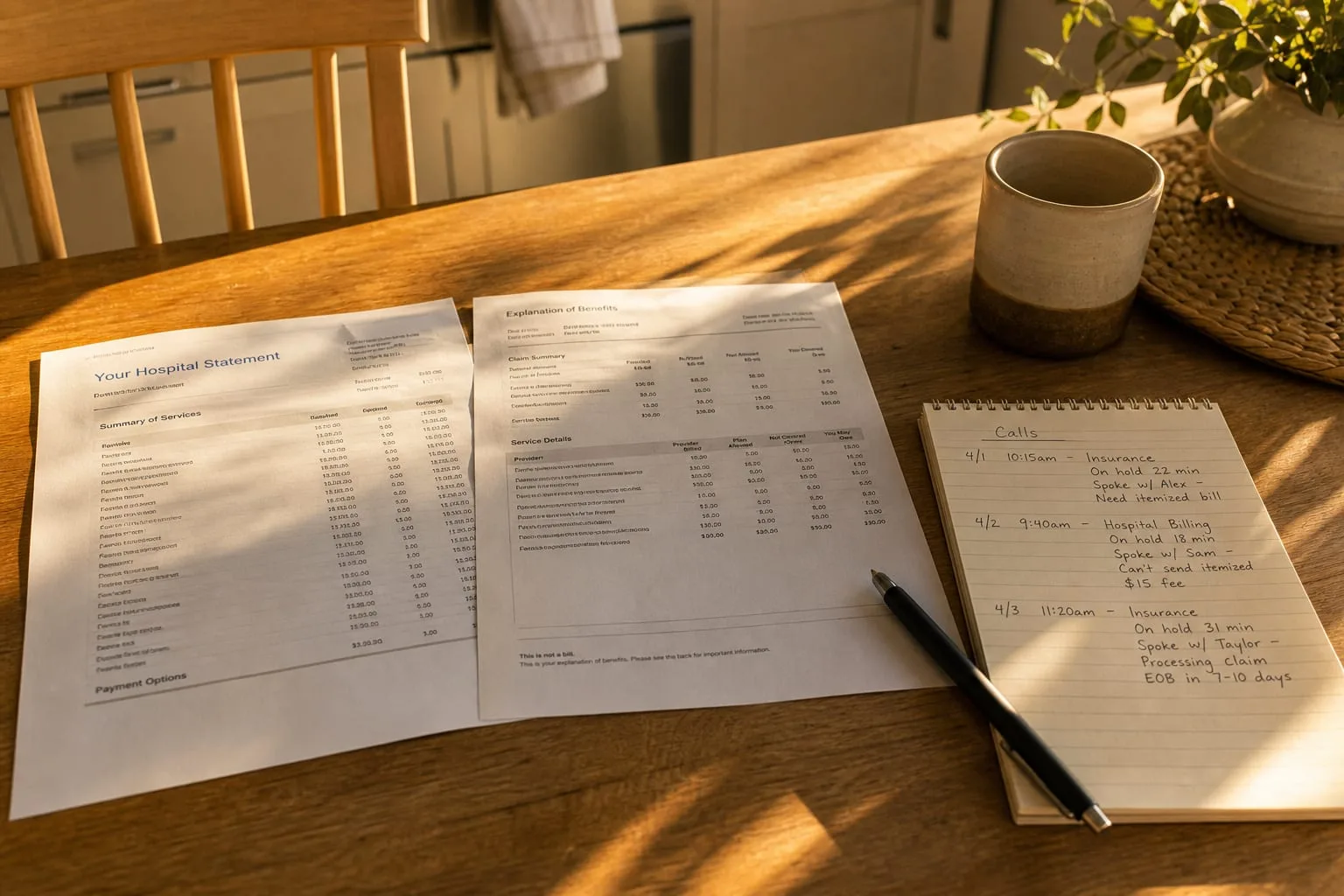
The statement that arrives three weeks after a procedure looks like it came from one place. It has one logo, one account number, one amount due. In practice it was assembled by four or five separate parties who never spoke to each other, and only one or two of them can change anything on it. Calling the wrong one is how people spend forty minutes on hold and hang up with the same number they started with.
A household does this maybe twice a decade. A company that buys health coverage for four hundred people does it every week, with a named contact and a contract behind it. The difference in outcome is less about leverage than about knowing who is standing where.
Two documents, two different authors
Before you argue about a charge, separate the paper. What the provider sends you is a statement or, if you ask for it, an itemized statement, which lists every service, supply and code the facility recorded. What the insurer sends is an explanation of benefits, usually shortened to EOB. That is not a bill. It is the insurer's arithmetic: what was charged, what the contract says the service is worth (the allowed amount), what the plan paid, and what is left with you.
The two documents are written by two organizations working from the same claim file and different rulebooks. The provider's number is what the provider asked for. The insurer's number is what the network contract permits. When they disagree, the gap is almost never a mistake in addition. It is a disagreement about a code, a date, or whether the plan was in force.
Line them up side by side and match them by date of service and by procedure code. If a charge appears on the provider statement with no matching line on the EOB, the claim for that item probably never reached the insurer, or reached it and was rejected before it was ever processed. That is a different problem from a denial, and it goes to a different person.
The coder, and why nobody thinks to ask about them
Somewhere between the exam room and the mailbox, a person you will never meet read the clinical note and translated it into numbers. Those numbers are procedure codes and diagnosis codes, and they determine the price, whether the plan covers it, and whether it counts as preventive or diagnostic. That person is a medical coder, and they are the party in the transaction that patients almost never think about.
This matters because most disputed medical bills are not pricing disputes. They are coding disputes wearing a pricing costume. A screening colonoscopy that becomes diagnostic because a polyp was removed. An office visit billed at a higher level of complexity than the eight minutes in the room suggests. A facility fee attached to a clinic that was bought by a hospital system last year. A drug billed by units where the units were entered wrong by a factor of ten.
The coder works inside what the industry calls the revenue cycle, the whole path from scheduling to final payment. Coders do not usually take patient calls. But a billing representative can route a question to coding review, and that phrase is the one that gets movement. Asking for a coding review is a specific, answerable request. Asking why the bill is so high is not.
Who to call, and what each one can actually do
| Who | What they see | What they can change |
|---|---|---|
| Front desk or registration | Your demographics, insurance card on file, referral and authorization notes | Fix a wrong plan ID, a stale policy, a misspelled name. Small errors that cause large denials |
| Provider billing representative | The claim as submitted, payments received, adjustments, your balance | Send a corrected claim, request coding review, apply financial assistance, set up a payment plan, hold the account while a dispute runs |
| Coding or charge integrity staff | The clinical note against the codes billed | Change the code itself, which is often the only change that moves the number |
| Insurer member services | The claim as received, the plan's rules, the network contract's allowed amount | Reprocess a claim, correct an eligibility error, open an appeal, confirm whether a provider was in network on that date |
| Outside billing or collections vendor | Balance, account status, payment history | Take a payment. Usually nothing else. They cannot rewrite the clinical record |
There is a fifth party that never appears on the envelope: the clearinghouse, the middleman that carries claims electronically from provider to insurer and checks their formatting on the way. When a claim is rejected there rather than denied by the plan, it can sit in limbo for weeks while the provider's system shows it as outstanding and you get a statement for the full amount. A billing representative can see that status. You cannot. So ask directly whether the claim was accepted by the payer, and on what date.
Debt that has moved to an outside collector is governed by consumer credit and collection rules, which the Consumer Financial Protection Bureau is responsible for overseeing. That is worth knowing mainly because it tells you the vendor's job is narrow. Disputes about what the service was belong upstream, with the provider, and asking the provider to recall the account while a coding question is open is a normal request.
What a company does at volume, and which parts scale down
An employer with a self-funded plan, meaning it pays claims out of its own money and hires an administrator to process them, does not call member services. It has a service representative, quarterly claims reporting, and a broker who can escalate. It runs the same checks a household runs, just continuously and with a spreadsheet.
Three of those habits scale down to a kitchen table without any of the leverage.
- Match every claim to a document. Companies reconcile the administrator's report against invoices. You reconcile the itemized statement against the EOB. Same operation. If a line has no partner, that is your first question.
- Date every contact. Large payers and providers log calls by reference number. Keep your own log: date, name, what was promised, what number they gave you to call back. In a dispute that runs four months across three departments, the person with the timeline wins the disagreement about what was said.
- Ask for the correction in writing, in the sender's own language. A company asks for a corrected claim with a specific code and date of service. A household can ask for exactly the same thing. Precision travels better through a call center than frustration does.
What a household cannot replicate is the standing relationship, and that is fine, because a household is arguing about one episode of care rather than a year of them. The narrowness is an advantage. You know exactly how long you were in the room, who came in, and what was actually done. The coder had a note. You were there.
Start with the itemized statement and the EOB on the same table, find the line that does not have a partner, and take that one question to the billing representative with a date and a code attached. Most bills that get corrected are corrected because somebody asked a small, specific question of the right desk.