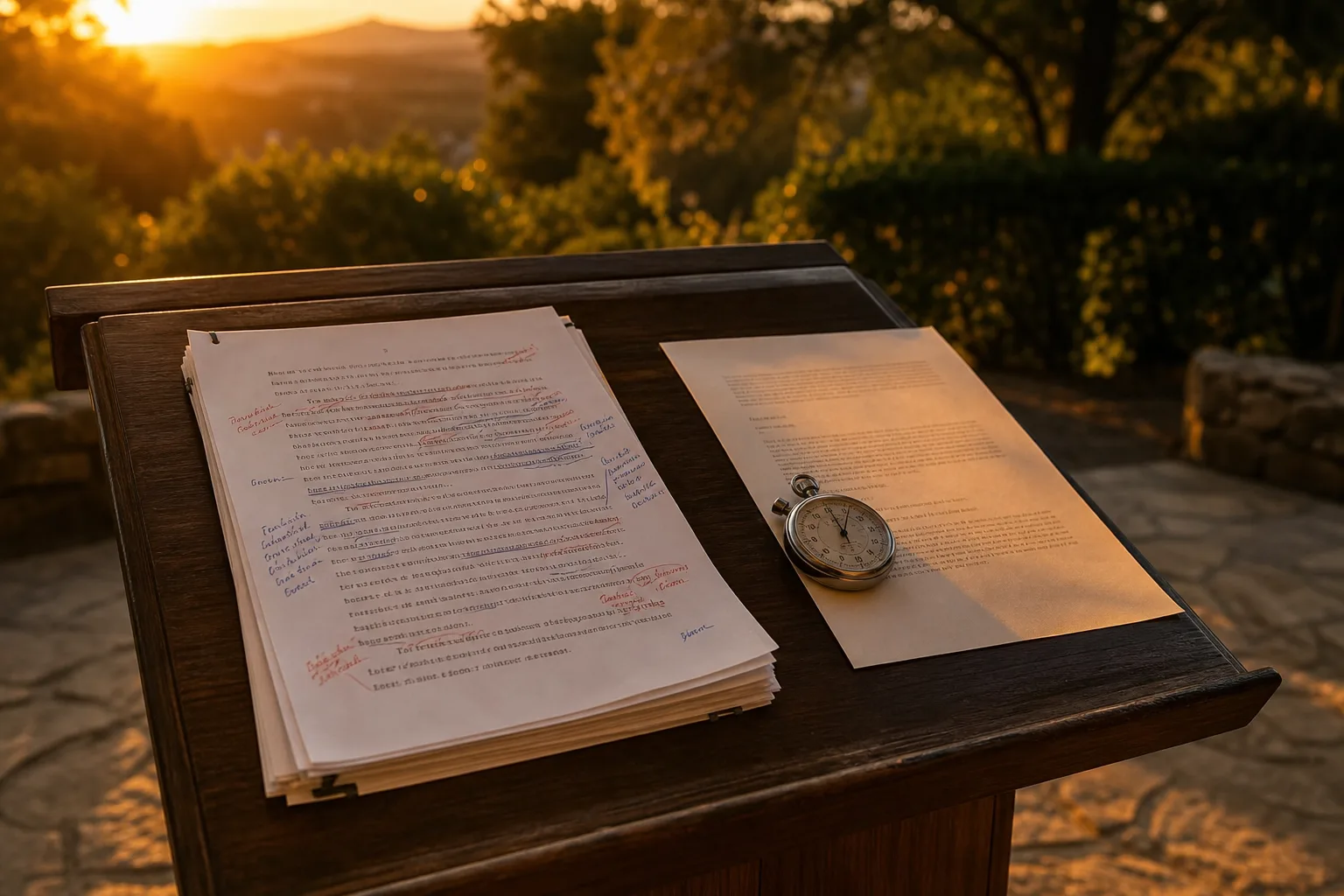
The billable hour is not an ancient custom. It is an accounting habit that spread out of law firms in the middle of the last century, when partners started keeping timesheets to see which files were profitable. The timesheet was a management tool first. Then somebody noticed you could hand it to the client, and the hour became a price. Consultants adopted it, then agencies, then the freelance writers who worked for both. For decades, if you wanted words written by a professional, you were quoted a rate and an estimate, and the two rarely met.
That has shifted, and the shift is most visible in the smallest, most self-contained kind of writing work: a single speech. What follows is a composite of engagements I have watched repeat with enough regularity that the pattern is more useful than any one file.
How the clock came to price a piece of writing
Hourly billing solved a real problem for the seller. Nobody knows in advance how long an unfamiliar problem takes. Charging for time transfers that uncertainty to the buyer, who absorbs it in exchange for, in theory, paying only for effort actually spent. The Bureau of Labor Statistics tracks writers and authors as an occupation, and the trade has always been full of people whose output per hour varies wildly by day, mood, and subject.
The trouble is that a speech is not an open-ended problem. It has a known length, a known audience, a fixed date, and one person who has to be comfortable saying it out loud. The uncertainty the hourly rate exists to absorb is mostly not there. What is there instead is a different uncertainty: how many times the client will change their mind. Hourly billing prices that uncertainty too, but it prices it after the fact, on an invoice, which is the worst possible moment to discover it.
One keynote, billed two different ways
A regional trade association books its chief executive for the opening session of its annual conference. Twenty-two minutes, roughly three thousand people in the room, and a policy announcement buried in the middle that the board has argued about for a year. They hire an outside writer on an hourly basis with a verbal estimate of a few days of work.
The writing takes about what the writer thought it would. Everything around it does not. There is an intake call, then a second intake call because the first one happened before the board had settled the announcement. There is a draft, then comments from the general counsel, then comments from the policy director that contradict the general counsel's. There is a version the CEO reads standing up in her office and dislikes for reasons she cannot articulate for another two days. There is a rewrite of the opening that has nothing to do with writing and everything to do with an internal disagreement about tone.
Every one of those hours is legitimately billable. None of them produced a better speech than the one that existed after round two. The invoice arrives and it is not close to the estimate, and the association's finance director, who approved a number in her head and not on paper, now has to explain a variance to a board that just spent a year arguing about the announcement.
The next year they buy the same speech as a fixed fee for the deliverable. The number is agreed before anything starts. It covers an intake interview, a draft, two rounds of revision, and a read-through with the speaker. Additional rounds are priced separately and stated in the engagement letter. The association pays roughly what the previous year's invoice came to, and the difference is that they knew the figure in March.
What actually changed, and it was not the writing
Nothing about the drafting improved. What changed was that the fee stopped rewarding the parts of the job that produce no value. Under the hourly arrangement, the writer had no financial reason to consolidate three reviewers into one comment sheet, and the client had no financial reason to do it either, because the cost of not doing it was invisible until the bill landed.
Under the fixed fee, both sides care about the same thing. The writer wants the internal disagreement settled before the first draft, because a second draft written against a moving target costs him money. The client wants it settled too, because round three is a line item now. So the intake call gets the counsel and the policy director on it together. The tone question gets asked at the start instead of surfacing at the end. Firms selling speech writing services now largely quote this way, with the scope, the revision count, and the turnaround written down before a word is drafted, and the discipline of writing that down is most of what fixed the problem.
One speech is not forty speeches
Here is where the household buyer and the institutional buyer diverge, and it matters more than the pricing model itself.
Someone commissioning a eulogy, a retirement toast, or a father-of-the-bride speech is buying one thing, once, and will never do it again. For that buyer the fixed fee is close to strictly better. The stakes are emotional, the revision instinct is unpredictable, and the last thing you want during a hard week is a meter running while you decide whether the third paragraph is right. The flat number is not just a price. It is permission to take your time with the part that is hard.
An organization buying forty speeches a year is in a different position. At that volume the uncertainty averages out, which is the whole argument for an hourly rate: some speeches run long, some run short, and across a year it evens. What does not even out is the review process. Volume buyers who move to fixed fees usually find the savings are not in the writing at all. They are in the meetings that stop happening, the reviewers who get consolidated, and the templates that emerge once the same writer has done a dozen and knows the speaker's rhythm. That is why the retainer, priced per speech or per month with a stated number of deliverables, has become the standard arrangement for a comms department rather than a straight hourly engagement.
The questions that settle it before you sign
- What exactly is the deliverable? Word count or minutes, and in what form.
- How many revision rounds are included, and what counts as a round?
- Who on your side is allowed to give comments, and does one person consolidate them?
- What happens if the event moves or the content changes after the draft?
- What triggers an additional charge, and at what rate?
A writer who answers those crisply has priced the work before, and a client who can answer the third one has a review process that will not eat the budget. Those two facts together predict the outcome of the engagement better than the hourly rate does.
The hour is still the right unit for genuinely open-ended work: research with no known endpoint, an advisory relationship, a crisis where nobody can say what next week looks like. A speech with a date on it is not that. It is a defined object, and once buyers on both ends of the scale started insisting on being quoted for the object rather than the clock, the market quietly rearranged itself to sell it that way.