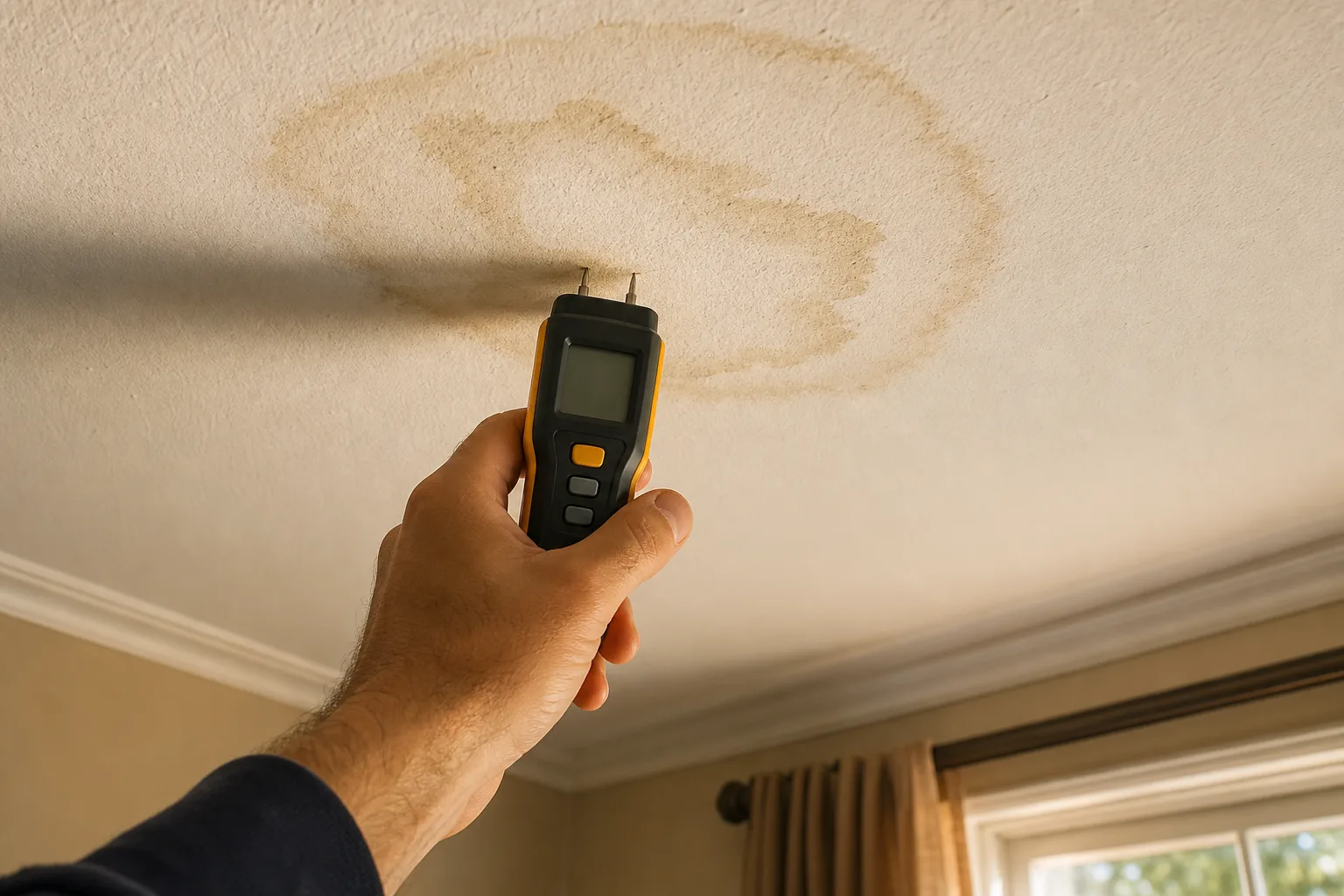
The house was a 1978 two-story on a quarter acre, four bedrooms, one owner since 1991. Everything in the listing photos was tidy. The thing that mattered was about eighteen inches across, brown at the edges and lighter in the middle, on the ceiling of the back bedroom, directly under the hall bathroom. The buyers saw it at the second showing. They were already under contract, with ten days left on their inspection contingency, the window in a purchase agreement during which a buyer can walk or renegotiate based on what an inspection turns up.
Two inspectors looked at that stain within the same week. One was hired by the buyers. The other had been engaged a month earlier by a different buyer whose financing fell through, and the seller, unusually, handed over that report. So there were two write-ups of one defect, produced eleven days apart, and they are a clean illustration of what a survey is actually for.
What the first report said, and why it said it
The earlier report described the stain in one line: Moisture staining observed at bedroom ceiling below second-floor bathroom. Recommend evaluation by a licensed plumbing contractor prior to close.
Nothing in that sentence is wrong. It is also close to useless, and it is worth understanding why an inspector writes it that way, because the reason is structural rather than lazy.
A home inspection in most states is a visual, non-invasive examination. The inspector is not supposed to cut drywall, pull a toilet, or open a wall. On top of that, the inspector carries liability for anything missed and almost none for anything over-flagged. Those two facts push in the same direction. If you are judged on what you failed to mention and never on how much work you created, the safe move on every ambiguous finding is to name it, disclaim it, and refer it out. A report built entirely that way will have forty of those lines in it. It will be defensible. It will not tell the buyer a single thing they can act on.
That is the failure mode worth naming. A barely adequate inspection converts the house into a list of unknowns. A good one converts unknowns into either a number or a short, specific question with a name attached to it.
What the second inspector did with the same stain
The buyers' inspector spent about twenty-five minutes on it. The sequence is the whole point, so here it is in order.
He touched the stain with a pin-type moisture meter, which drives two small probes into the surface and reads the electrical resistance between them. Wet material conducts; dry material does not. The reading was dry. He noted the edges were hard and well defined, the way a stain sets once it has dried and stopped spreading.
Then he went upstairs and tried to make it wet again, which is the part the first report skipped entirely. There are only a few ways water gets through that floor, and they can be separated by testing them one at a time.
- Supply. He checked the shutoffs under the sink and behind the toilet for corrosion and crust, the mineral signature of a slow weep. Clean.
- Drain. He filled the tub, then pulled the stopper and let the whole volume go at once, which loads the drain and the tub shoe in a way that a running shower never does. Then he filled the sink and did the same.
- Surface. He ran the shower for a full ten minutes with the curtain inside the tub, then a second run with water deliberately directed at the corner where the tub meets the tile.
- Fixture seal. He rocked the toilet at the base to check whether it moved on its flange.
After each step he went back downstairs and re-read the ceiling. The meter stayed dry through the first three. On the fourth, the toilet moved. Not much. Enough.
His write-up said so: the staining was historic and inactive, the tub drain and supply lines tested dry under load, and the toilet was loose at the flange with the probable original wax seal still in place. He recommended pulling and resetting the toilet with a new wax ring and flange inspection, and noted that if the flange or subfloor underneath had rotted, the scope would grow and should be re-priced at that point.
Why that difference is worth real money
Think about what each buyer could do on the Monday morning after they got their report.
The first buyer had a referral and a deadline. To price the repair, they had to find a plumber willing to visit a house they did not own, get on a schedule, and quote a job whose scope nobody had defined. In practice, that takes longer than most contingency windows allow. The buyer then faces a bad choice: ask the seller for a big round credit against an undefined problem, which sellers refuse because it looks like a fishing expedition, or waive it and absorb whatever it turns out to be. An undefined ceiling stain under a bathroom covers an enormous range, from a wax ring and an hour of labor to rotted subfloor, a new flange, a torn-out tile floor and a replaced ceiling. The gap between the cheap end and the expensive end of that range is the entire negotiation.
The second buyer had a scope. Pull and reset the toilet, with a named contingency if the flange is gone. That is a job a plumber will quote over the phone from a description, and it is a job a seller will either credit or complete, because the number is small and the request is specific. The stain itself, being inactive, became a paint question rather than a water question.
Same defect. Same house. The report decided whether the buyer had leverage or just anxiety.
How to tell which kind of inspector you are hiring
You cannot evaluate this from a website, and price is a weak signal. Three things are not.
Ask for a sample report on a house of similar age, and count how many findings end in "recommend evaluation by a qualified contractor" with nothing before it. Some of those are legitimate: a cracked heat exchanger, a questionable foundation crack, a panel with a brand known for failures. If almost everything ends that way, you are buying a list, not an opinion.
Ask what the inspector does to test a drain, and listen for whether the answer involves loading it. Running a faucet for thirty seconds tests nothing.
Attend the inspection, and stay for the last half hour. The verbal summary is where an experienced inspector tells you which three items actually matter and which thirty are normal for a house of that age. That sorting is the judgment you are paying for, and much of it never makes the written report because the written report has to be defensible.
One more thing on scope. A general inspection does not include radon, which the Environmental Protection Agency is responsible for, and it does not include sewer lateral condition or most pest work. Those are separate orders. Decide which ones you want before the inspection, not after, because each one has its own scheduling lag and your contingency clock does not pause for it.
A good report is not the one that lists the most. It is the one that leaves you holding fewer open questions than you had the day before, each remaining one with a name, a next step, and a rough size. That is what the fee buys, and on a house with a brown ring on a bedroom ceiling, it is the difference between negotiating and guessing.