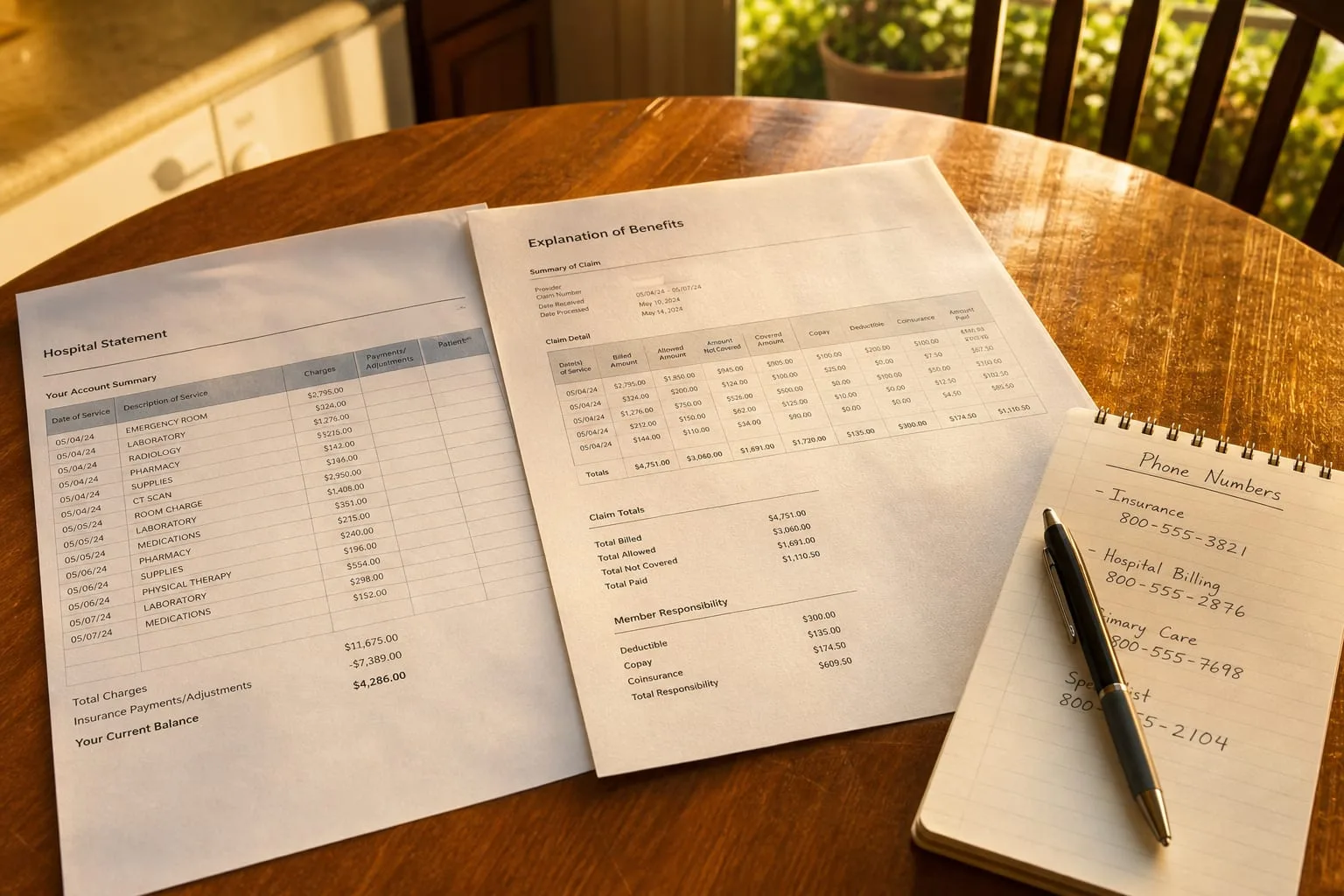
The envelope arrives three weeks after the visit, and the number on it does not match anything you were told. That is the normal experience, not a sign that something went wrong. A medical bill is not written by one person. It is assembled in stages by four or five people who work in different departments, sometimes different companies, and who each control a narrow slice of what you are looking at. If you call the wrong slice, you get a polite person who genuinely cannot help you, and you hang up thinking the bill is final. It usually is not.
So the useful first move is not to argue. It is to figure out which set of hands produced the line that bothers you.
Three documents, and only one of them is a bill
First-timers almost always try to read the wrong piece of paper. There are three, and they come from two organizations.
The summary statement is what the provider mails you. It shows a total charge, an insurance payment, an adjustment, and a balance. It is designed to be short. It will not tell you what you were charged for, and no amount of staring will make it.
The itemized statement is the line-by-line version: every supply, drug, room hour, and procedure, each with a code. You usually have to ask for it. Ask. It costs nothing and it is the only document where an error is visible.
The explanation of benefits, or EOB, comes from your insurer, not the provider. It is not a bill, and it says so somewhere in small type. What it does is show the insurer's decision: what it considered the allowed amount (the maximum it recognizes for that service under its contract with that provider), what it paid, and what it assigned to you. The gap between the provider's charge and the allowed amount is the adjustment, and it is written off. You do not owe it.
Put the itemized statement and the EOB side by side. Where they disagree, you have found your question, and the disagreement itself tells you whose desk to take it to.
The people who built the bill, in order
Each line on that itemized statement passed through several jobs on its way to you.
The registrar or front-desk intake clerk typed your insurance information at check-in. That is a small job with large consequences. A digit wrong in a member number, an old plan on file, a subscriber listed as the patient when it is actually a spouse: all of these come back later as a denial that looks like a coverage problem and is really a typing problem. Registration errors are the single most common reason a first bill is wrong, and they are the cheapest to fix.
The clinician documented what happened. Not the price. The description.
The medical coder read that documentation and translated it into standardized codes: procedure codes for what was done, diagnosis codes for why. Coders are credentialed specialists and they work from the chart, not from memory of your visit. If a line describes a service you did not receive, or a level of visit that seems heavier than what happened, that is a coding question, and it is answered by pulling the chart.
The charge master, which is a price list rather than a person, attaches a dollar amount to each code. Those amounts are set institutionally and are largely disconnected from what any insured patient pays. The Centers for Medicare & Medicaid Services oversees hospital price disclosure, which is why most hospitals now post these lists publicly.
The biller sends the claim. The insurer's claims processor or, increasingly, an automated edit, decides how to pay it. Then a patient account representative at the provider handles you.
Which question belongs to which desk
| What is bothering you | Who owns it | What to ask for |
|---|---|---|
| No itemized detail, just a total | Patient accounts, provider side | An itemized statement with codes and dates of service |
| Wrong plan, wrong member ID, claim denied as "no coverage" | Registration, then billing | Correct the insurance on file and rebill the claim |
| A service listed that did not happen, or a visit level that looks high | Coding, via patient accounts | A coding review against the medical record |
| Denied as not medically necessary, or as out of network | The insurer | The denial reason code in writing, and the appeal deadline |
| You owe more than your plan's cost sharing suggests | The insurer first, provider second | The EOB showing allowed amount and patient responsibility |
| The amount is right and you cannot pay it | Financial counseling | Financial assistance application, or an interest-free payment plan |
The sequencing in that last column matters more than the wording. A billing representative cannot overturn an insurer's denial, and an insurer cannot fix a code the provider entered. Calling them in the wrong order does not just waste an afternoon; it can burn days off an appeal clock that started running when the EOB was issued.
The role first-timers skip
Almost every hospital, and many larger clinics, employs financial counselors, sometimes titled patient advocates or financial navigators. Their job is to sort out how a bill gets paid: screening for charity care, reducing balances under a written financial assistance policy, setting up a payment plan with no interest, checking whether you qualify for a program you have never heard of.
They are not collectors, and they are usually not the same people who answer the number printed on the statement. Nonprofit hospitals maintain written assistance policies with published income thresholds, and those policies frequently cover households well above what people assume. A first-timer will often accept a balance in full, on a credit card, without ever discovering that the same balance had a discount attached to it and a form to claim it.
Ask directly: "Do you have a financial counselor, and does this account qualify for financial assistance?" That one sentence gets you routed to a different department with different authority.
What to do with the first call
Call once, early, and use it to gather rather than to dispute. Get the itemized statement. Get the claim number. Get the name of the person you spoke to and the date. Ask whether the account is with the provider or has been placed with an outside agency, because that changes who you deal with. Then read the EOB against the itemized list, and make your second call the specific one.
Bills that go unquestioned tend to stay exactly as printed. Bills that get one targeted question, aimed at the desk that can actually answer it, move often enough that the hour is worth spending.