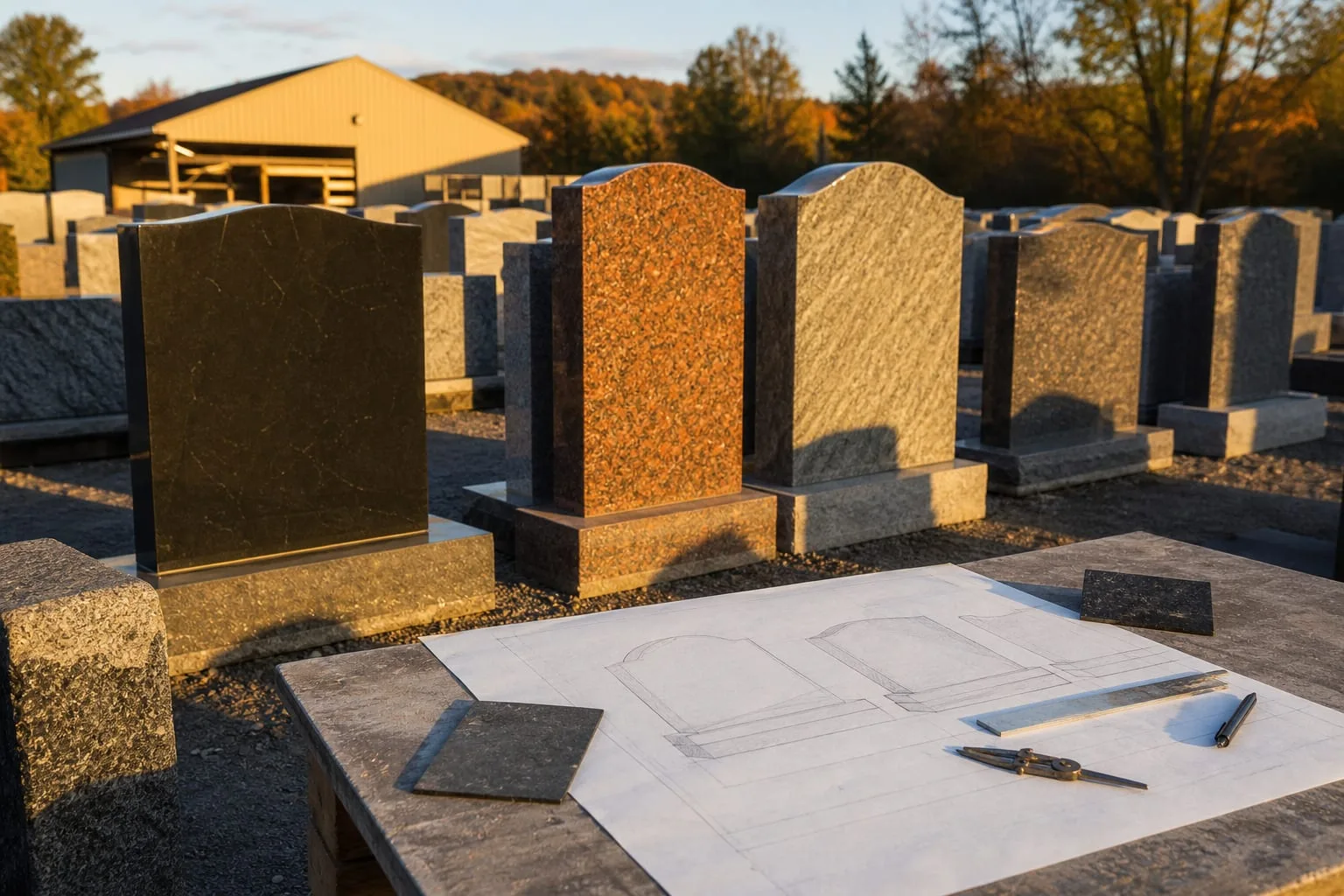
A family buying a memorial buys one. Maybe two in a lifetime. The company selling it moves hundreds or thousands a year, and almost everything about how the transaction is shaped comes from that difference in volume. The order form, the proof process, the delivery window, the warranty language: all of it was built by people doing this at scale, for people doing it once. That is not a criticism. It is the reason the process is as orderly as it is. But it means the points where a household's judgment is actually required are easy to skim past, because they are printed on paperwork designed for repetition.
Here is what the trade looks like now, and the five places where a decision hardens.
1. Where the stone comes from, and what your color choice commits you to
For most of the twentieth century, a monument dealer was a local shop near a cemetery, with a yard of granite out front and a sandblast room in back. Lettering was cut by hand, then later through a rubber stencil with abrasive blown against it. The granite itself came from a handful of American quarry districts, Barre in Vermont and Elberton in Georgia among the best known, and the color options a family saw were largely whatever those quarries were pulling and whatever the dealer had standing in the yard.
That changed as finished and semi-finished granite began arriving from quarries and fabrication plants overseas, and as larger firms consolidated retail locations across several states. The practical result: the color chart in front of you is now much longer, and the stone behind each swatch may travel a very long way before it reaches a foundation in your county.
Two things follow. First, color is a supply decision as much as an aesthetic one. A common gray or a widely quarried dark stone can usually be replaced or matched years later. An unusual color, especially one with heavy veining or a distinctive figure, may be discontinued or may simply be pulled from a different part of the deposit by the time anyone needs a companion piece. Ask the salesperson directly whether the stone is a standing pattern the company stocks or a special order. That answer tells you more than the swatch does.
Second, granite varies within a color. The sample is representative, not identical. A large dealer with a yard can sometimes show you the actual block or slab. A smaller retail office that drop-ships from a central plant cannot. Neither arrangement is wrong, but if the exact appearance matters to you, buy from the one that can put your hand on the stone.
2. The proof is the real contract, and engraving only goes one direction
Somewhere in the order there will be a layout drawing: names, dates, an inscription, any emblem or carved element, drawn to scale. It may arrive as a printed sheet or an email attachment. It will ask for a signature or a reply approving it.
Treat that drawing as the item you are buying, because it is. The stone is a blank. Everything that makes it a memorial is removed material, and removed material does not come back. A misspelled maiden name, a transposed birth year, a middle initial the family never used, a nickname in quotation marks that half the relatives object to: all of these are correctable for free before approval and, after approval, are a new stone.
Read the proof out loud with a second person holding a source document. A death certificate, a birth record, a military discharge paper. Not memory. At volume, the shop is verifying that the cut matches the approved drawing, not that the drawing matches the truth. The truth is the family's job and it is assigned to you in writing.
Check the physical facts too: overall dimensions, which faces are polished, whether the base is included, and the finish on the top and sides. Those are priced items, and they are also the things people are surprised by when the piece is set.
3. Foundation, setting, and who is holding the shovel
Very few monument companies set a stone wherever they like. The cemetery controls the ground. In practice, one of three arrangements applies: the cemetery pours the foundation and charges the family, the cemetery requires its own crew to do the setting, or the dealer's crew does the work under the cemetery's specifications and inspection. Large cemetery organizations tend toward the second. They are managing thousands of markers and a mowing operation, and uniform foundations are how that stays manageable.
Get the setting arrangement in writing before you sign, along with the foundation charge, because that number frequently is not in the monument price. Confirm the orientation as well: which direction the inscribed face points, and where the stone sits relative to the grave and the neighboring lots. Once a foundation is poured and a stone is set on it, moving the piece a foot is a crew, equipment, and a new foundation. It is not a phone call.
4. What to leave blank on a companion piece
Companion markers, the ones covering two spaces, are where irreversible choices multiply quietly. The standard practice is to cut both names, both birth years, and only the date of death that has occurred, leaving the second death date for later. Some families ask for the second date to be left with a dash, some prefer nothing at all. Either is fine. What is not fine is discovering later that the layout left no room for the addition, or that the second date will be cut by hand on site in a lettering style that does not match the shop-blasted original.
Ask now who does the later date, what it costs at today's prices, and whether the company keeps the original artwork file. Large firms usually do keep the file, indexed by order number, and that record is worth having. Write the order number down somewhere a family member will find it in twenty years.
5. Who you are actually buying from, and who will answer in a decade
The name on the door may be a manufacturer with its own quarry contracts and fabrication plant, a dealer that finishes imported blanks, a retail office that brokers to a central plant, or a funeral home selling monuments alongside caskets. The Federal Trade Commission is responsible for the disclosure rules that govern how funeral goods and services are priced and presented, and itemized pricing has made these arrangements much easier to compare than they once were. Use that. Ask for the price of the stone, the engraving, the foundation, the setting, and delivery as separate lines.
Then ask the durability question: who honors the warranty, and what does it cover. Granite warranties typically address the material and the workmanship, not settling ground or mower damage. A larger organization has an advantage here worth naming plainly. It is more likely to still exist, still have your file, and still send someone out.
The order of operations matters more than the shopping. Confirm the cemetery's rules and foundation arrangement, choose a stone the company stocks or can reliably source again, then spend your careful hour on the proof with documents in front of you. Do it in that sequence and the only thing left to decide is what the inscription should say, which is the part that deserves the time anyway.