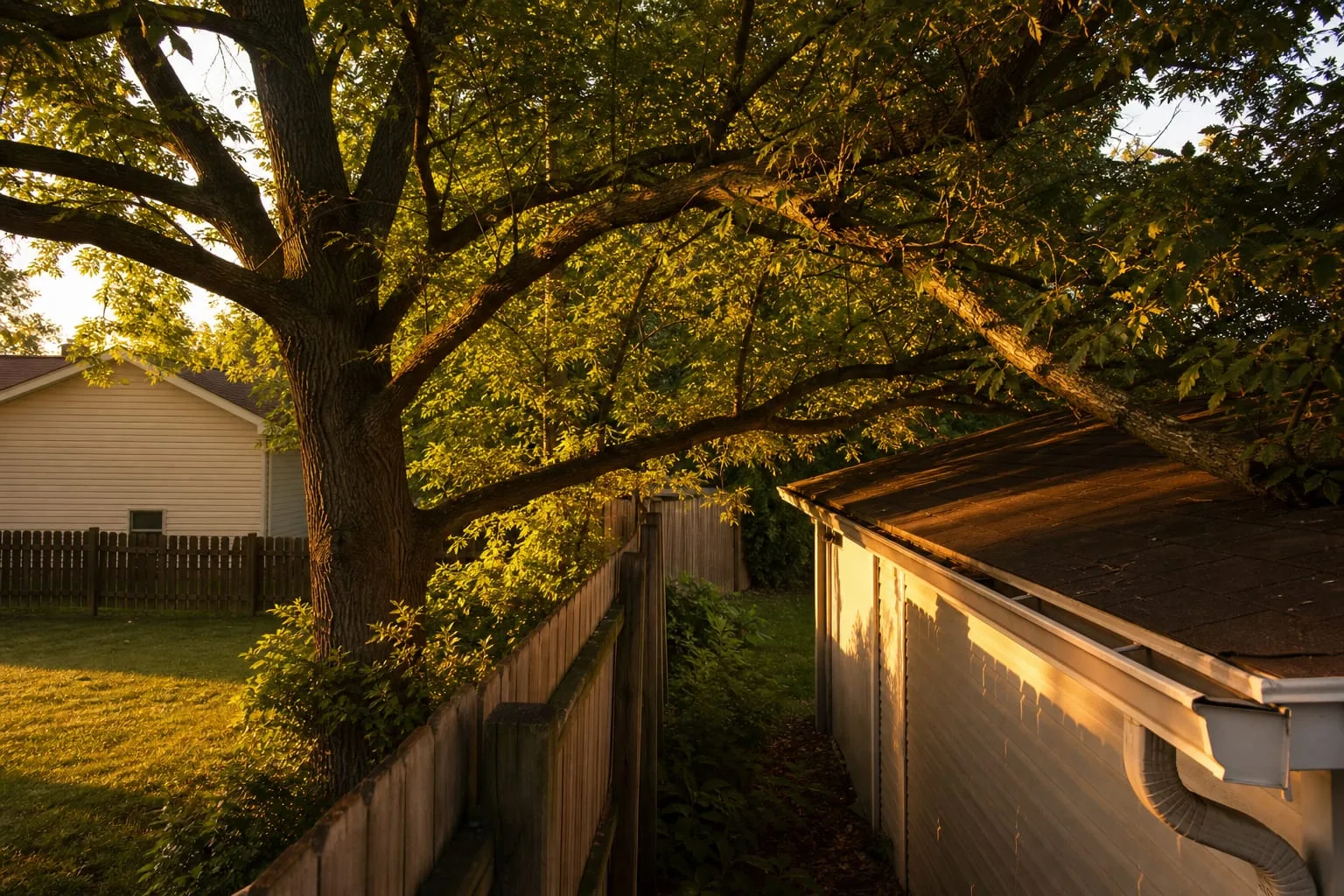
A limb from next door has been resting on your gutter for two summers and this spring it started rubbing the shingles. You could get a ladder. You could knock on the door. You could call a tree service and have it gone by Thursday. Each of those is a decision with a different cost if it goes wrong, and the reason households pick badly is not stubbornness. It is that most people face this once or twice in a lifetime, with no practice and no file.
Utility vegetation crews, university grounds departments and apartment operators with a few thousand doors face it constantly. They have built a routine, and the useful part of that routine is not their budget. It is the order they do things in.
What volume teaches that a single house never gets to learn
An organization that trims near lines or along fence rows in dozens of places a year has learned which disputes turn expensive. The pattern is consistent: the ones that cost money are the ones where somebody cut first and documented second. So the routine inverts it. Before a saw comes out, someone establishes where the line is, records the condition of the tree, and gives written notice to the adjoining owner. Not because a statute always demands it, but because doing it out of order has already cost them once.
They also work to a standing instruction rather than a judgment call. Crews are told what they may remove without approval, what requires a supervisor, and what stops the job entirely. That distinction is the thing worth stealing. A household does not need a policy manual. It needs to know, before the truck arrives, which cuts are clearly its own business and which ones are not.
The rough dividing line in most states: what hangs over your property, you may generally cut back to the boundary, at your own expense, without killing the tree. What stands on the other side of the line is not yours to fell, top, or poison, and the money damages for a tree destroyed without permission are frequently far larger than people expect, because the measure can be the value of the tree rather than the cost of firewood removal. That is the cut that stops the job.
The three documents that carry the decision
Large operators lean on paper because paper is cheaper than argument. Three items do almost all the work.
- A boundary record. A recorded plat or a prior survey is often enough to see whether the trunk is on one side, the other, or straddling. A new survey costs real money and is worth it only when the trunk position or the fence line is genuinely in doubt, not when you are annoyed. A trunk sitting on the line usually makes the tree jointly owned, which changes everything downstream.
- A written assessment from a consulting arborist. This is the document households skip and organizations never do. It states species, condition, defects, and whether the tree presents a hazard. It costs a fraction of a day of an attorney's time and it converts "I think that thing is going to come down on my garage" into a finding somebody else has to answer. It also protects you if the tree is healthy and the honest answer is that you have a leaf problem, not a risk problem.
- Dated notice. A short letter describing the condition, attaching the assessment, and asking for a response by a specific date. Big landlords send these as a matter of course. It is the cheapest document in the sequence and the one that most often ends the matter.
Where the household case is genuinely different
Two differences are real and neither favors copying the corporate playbook wholesale.
First, an organization has no relationship to preserve. It will never share a driveway with the adjoining owner. You will. Which means the sequence a utility runs cold, notice then contractor then invoice, should for you start one step earlier, with a conversation that is not a demand. Many boundary tree problems are two people who each assumed the other did not care.
Second, the cost math is not the same. A company amortizes a legal opinion across hundreds of sites. Yours applies to one tree. That argues for spending on the arborist and the boundary record, which resolve facts, and being slow to spend on counsel until there is an actual disagreement about what those facts mean.
One thing does transfer exactly: hire crews the way an institution does. Certificates of insurance, workers' compensation coverage, and a written scope naming each cut. Tree work is among the more hazardous trades in the country, and the Occupational Safety and Health Administration is the federal body responsible for the safety standards those crews work under. A company without coverage is a company whose injury becomes your problem.
The order to run it in
- Establish where the trunk sits, using records you already have if they are clear.
- Have the tree assessed in writing if there is any claim of hazard.
- Talk to the neighbor with the assessment in hand.
- Send dated written notice if the conversation stalls.
- Confine any work you commission to your side of the line, with the scope in writing.
Judgment here is not knowledge of tree law. It is knowing which step you are on, and refusing to skip to the saw. That is the whole of what a large operator knows and it is available to anyone willing to spend one afternoon on documents before spending a weekend on a ladder.