A broken supply line does not care what state you live in. The rules about who may show up, what they may cut out, and what they must write down before they do it care a great deal. Two households with identical losses, one in Houston and one in rural Idaho, can get legitimate, competent responses that look nothing alike on paper. The water behaves the same. The paperwork does not.
For a single household this matters once, maybe twice in a lifetime. For a restoration company running forty jobs a week across a metro area that straddles a state line, it is the whole operating model: separate crews, separate licenses, separate forms in the truck. Knowing which rules are real law and which are industry habit is what keeps a homeowner from being told a thing is required when it is only customary, or being told a thing is optional when the state says otherwise.
The drying standard is a standard, not a statute
Most reputable water mitigation work in the United States is performed against a written industry standard for professional water damage restoration, published by a private standards body and widely referenced by insurers and trainers. It sets out how losses are categorized by how clean the water was, how affected materials are classified by how fast they dry, and what a drying plan and daily moisture readings should look like.
Here is the part people misunderstand. That document is not a law anywhere. No state legislature passed it. A contractor who departs from it has not broken a statute. What the standard actually functions as is a yardstick: insurers use it to judge whether invoiced equipment and labor were reasonable, and attorneys use it when a drying job goes wrong and someone has to explain why a wall was left wet.
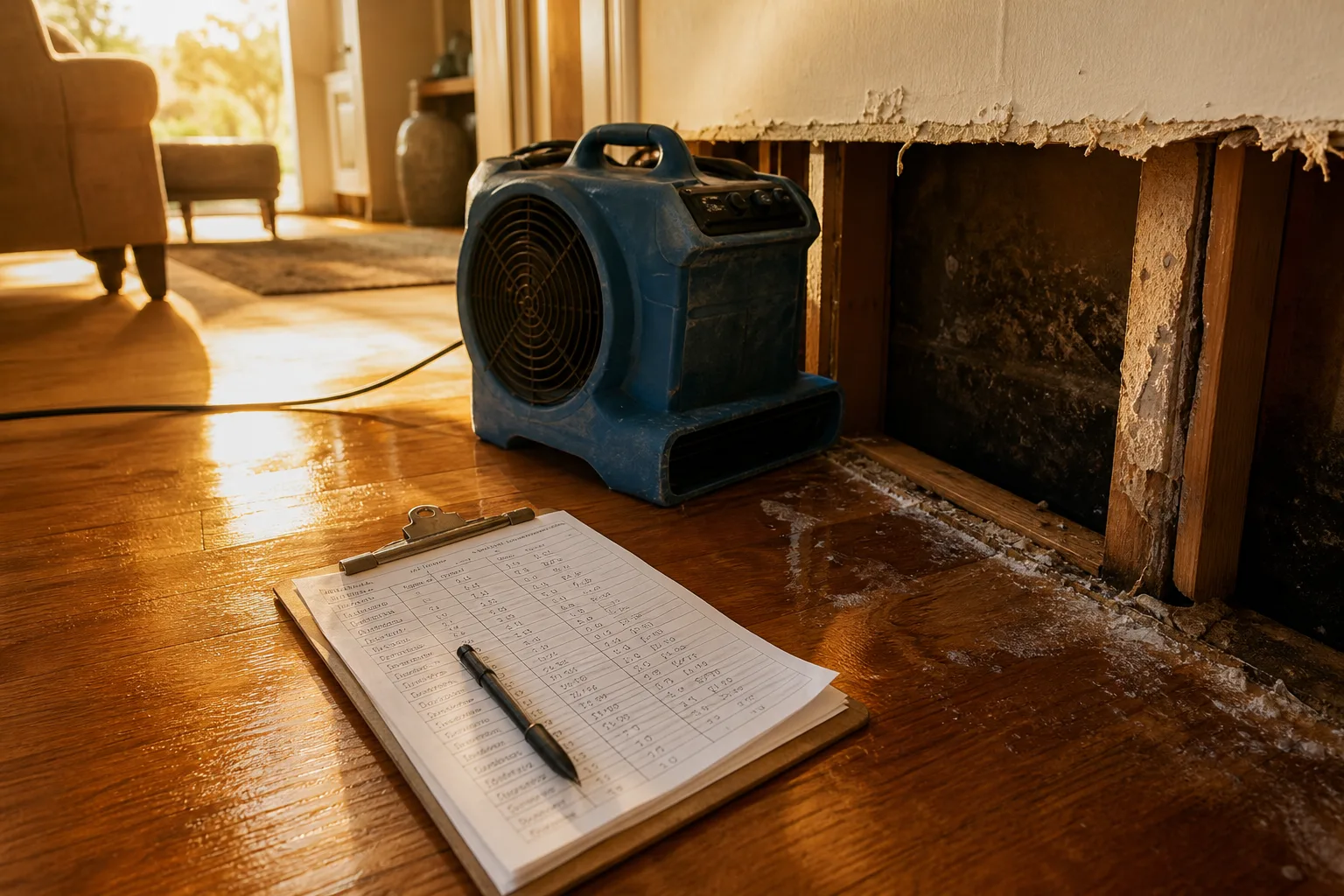
The practical consequence in the first forty-eight hours is documentation. A crew working to the standard takes initial moisture readings in affected and unaffected areas, logs them daily, and records temperature and relative humidity. A household is entitled to ask for copies of those logs. At volume, the companies that survive insurer audits are the ones whose field technicians photograph and log without being asked, because a missing day of readings on one job out of forty is the one that gets questioned.
Who may legally touch mold, and where that question has an answer
This is the single largest regional split, and it surprises people. In a handful of states, mold assessment and mold remediation are licensed activities with real teeth. Texas, Florida, Louisiana, New York and a few others have statutory regimes. In many other states there is no mold license at all, and the work is governed only by general contractor licensing, if that.
The licensed states tend to share two features worth knowing before you hire anyone. First, there is usually a square-footage or scope threshold below which the work is treated as ordinary cleanup and above which a licensed remediator is required. Second, several of these states separate the role of the person who assesses and writes the protocol from the person who performs the removal, so that the party diagnosing the problem is not the same party billing to fix it. That separation is a consumer protection, and it exists precisely because the incentive to find more mold is obvious.
Within forty-eight hours you are usually still in mitigation, not remediation. Water that has been standing for two days in a warm house, though, can move you across that line quickly. The useful question to a contractor on day one is not "are you certified," which almost everyone is, but "does this state license this work, and are you the assessor or the remediator." In a non-licensing state, the honest answer is that no license exists, and the vetting shifts to references, insurer relationships and whether the moisture logs show up.
Demolition rules that outrank the drying schedule
Cutting wet drywall two feet up is routine. It stops being routine when the house predates 1978 and the cut goes through painted surfaces, or when the flooring being pulled is a nine-by-nine vinyl tile from the 1960s.
The Environmental Protection Agency oversees federal rules on lead-safe work practices in older housing and on asbestos handling, and those rules do not pause because a basement is flooding. Firms performing renovation that disturbs painted surfaces in pre-1978 homes generally need certification and must follow containment and cleanup practices. Asbestos adds a second layer, and here state and even county rules diverge sharply: some jurisdictions require testing before demolition of suspect materials, others require licensed abatement contractors for quantities that elsewhere a general contractor could remove.
Disposal is local in a way nothing else is. Where wet carpet, pad and drywall may be taken, whether a roll-off can sit on the street without a permit, and whether suspect materials must be manifested are decided by the county landfill and the city public works department. A household handles this once and asks. A company doing this at volume keeps a list by jurisdiction, because getting a load rejected at a transfer station eats half a day.
What you sign in the first two days
The emergency services authorization a crew hands you at the door is a contract. It typically authorizes mitigation at prevailing rates rather than at a fixed price, and it may include a direction to pay, which tells your insurer to send mitigation money straight to the contractor. That is normal and often sensible. It is also worth reading at eleven at night with water on the floor, which is exactly when nobody does.
Protections here are again regional. Several states cap or condition what can be assigned to a contractor out of an insurance claim, Florida having rewritten its rules after years of disputes. Many states give a right to cancel a home solicitation contract within a few business days, and some suspend or modify price and contract rules during a declared emergency, including anti-price-gouging statutes that activate only when a governor declares one. Rental housing adds landlord habitability duties with their own notice periods, set by state and sometimes city ordinance.
Ask for the scope in writing before equipment runs, keep every moisture log, and photograph the room before anything is cut. Those three habits travel across every state line and make the rest of the rules easier to enforce when you need them.