A regional property manager running a few dozen mid-rise apartment buildings has something almost no homeowner has: a control group. Two buildings put up by the same developer in the same year, same lobby layout, same tile, same cleaning contractor, same number of units. When one of them starts costing more than the other, the difference is visible in the ledger, and it can be chased down to a cause.
In this case the thing that stood out was the floor care line. One building was being recoated roughly twice as often as its twin, and had already been stripped back to bare tile and resealed once in a period when the other had not. Same vendor, same price per square foot, same spec on paper. The only physical difference anyone could name was a lobby renovation a couple of years earlier, during which the entry matting had been replaced with a shorter run to show off a new stone threshold.
Eight feet shorter, give or take. That was the whole of it.
Why grit works like sandpaper, and why shortening the mat matters more than it sounds
Floor finish is a polymer coating, applied wet and left to cure into a clear, slightly soft layer that takes the wear so the tile underneath does not. It is designed to be sacrificial. The question is only how fast it gets sacrificed.
What eats it is not foot traffic in the abstract. It is the soil carried in on shoes, most of which is mineral: quartz sand, ground stone, road grit. Quartz is harder than the finish and harder than the vinyl or terrazzo below it. A shoe pressing a grain of sand into a coating and then sliding it an inch is doing, on a very small scale, exactly what a sanding belt does. Multiply that by every footfall across a lobby during a weekday morning and the coating does not wear evenly, it mills.
Once the surface is scratched, two further things follow. Scratched finish scatters light, so the floor looks dull, and a dull floor gets burnished more often to bring the shine back. Burnishing is a high-speed buffing pass that generates heat and takes a little coating off every time. Meanwhile the scratches hold soil that mopping cannot lift, so the floor greys, and greying triggers the decision to strip and start over. A recoat is a modest per-square-foot charge. A full strip, neutralize, seal and multiple coats is several times that, done overnight, with the lobby closed.
Matting interrupts the chain at the only point where it is cheap. The working rule in the trade is based on stride length rather than square footage: an adult stride lands roughly every two and a half feet, so a mat needs to be long enough that each shoe makes contact with it several times before it reaches hard floor. Fifteen feet of combined matting gets you about six contacts per foot. Seven feet gets you two or three. The soil that does not come off in those first few steps does not stay on the shoe. It is deposited on the finish, and it stays in the building until someone removes it.
The costs that showed up in other budgets
The floor line was the one that got noticed, because it was the one where two near-identical buildings could be compared side by side. It was not the largest share of the difference. Soil that enters a building does not politely stay in the lobby.
- Elevator door tracks. Grit migrates to the sill and packs into the track. Doors that drag trigger more service calls, and the calls are billed at a trip rate whether the fix takes five minutes or an hour. The building with the shorter mat had a noticeably busier elevator service history.
- Air filters and coil cleaning. Foot traffic puts fine particulate into the air. Lobby and corridor air handlers load up faster, filters get changed off-schedule, and coils that run dirty move less air for the same fan energy. The cost is split across a maintenance contract and a utility bill, which is exactly why nobody traces it back to a doormat.
- Corridor carpet. Carpet does not wear out so much as it gets cut. Abrasive soil works down to the base of the pile and severs fibers at the root under load. The visible result is traffic lanes that look matted and shaded, and in a rental building that appearance drives a replacement decision years before the carpet has failed structurally.
- Unit turnover. Tracked-in soil ends up on unit entry flooring and on the lower eighteen inches of corridor and entry walls. Scuffing and grey marks at that height are repainted at turnover. More of it means more prep time per unit.
- Slip incidents. Wet soil on a hard floor is slicker than either water or soil alone. The Occupational Safety and Health Administration is responsible for walking and working surface requirements where employees are present, and in a residential building the same physics applies to residents and to the cleaning crew. Incident reports carry administrative cost long before anyone involves an insurer.
None of those lines says "matting" on it. Each was absorbed by whoever owned that budget, and each looked like an ordinary cost of running a building until somebody set two buildings next to each other.
What the organization could see that a household cannot
This is the part worth carrying home. The property manager did not discover anything a careful homeowner could not have reasoned out. What the organization had was a second building.
A household has one of everything. One entryway, one furnace, one set of floors, and no way to know whether the hallway finish is wearing fast or normally, because there is nothing to compare it to. Deferred upkeep at home is almost never noticed as deferral. It is noticed, years later, as a floor that needs refinishing, a furnace that runs loud, a carpet that looks tired. Each of those reads as age. Age is nobody's fault, so nobody looks further.
The organization's advantage was not better judgment. It was a cost ledger with enough rows to notice an outlier, and a maintenance history long enough to ask what changed. A household can borrow half of that by writing down what it spends on repeat items and when. A furnace filter log on the inside of the utility closet door, a note of when the floors were last done, a line in the budget for carpet cleaning. Repeat intervals shortening is the signal. You do not need a second house if you have your own history.
What the fix looked like, and the household version
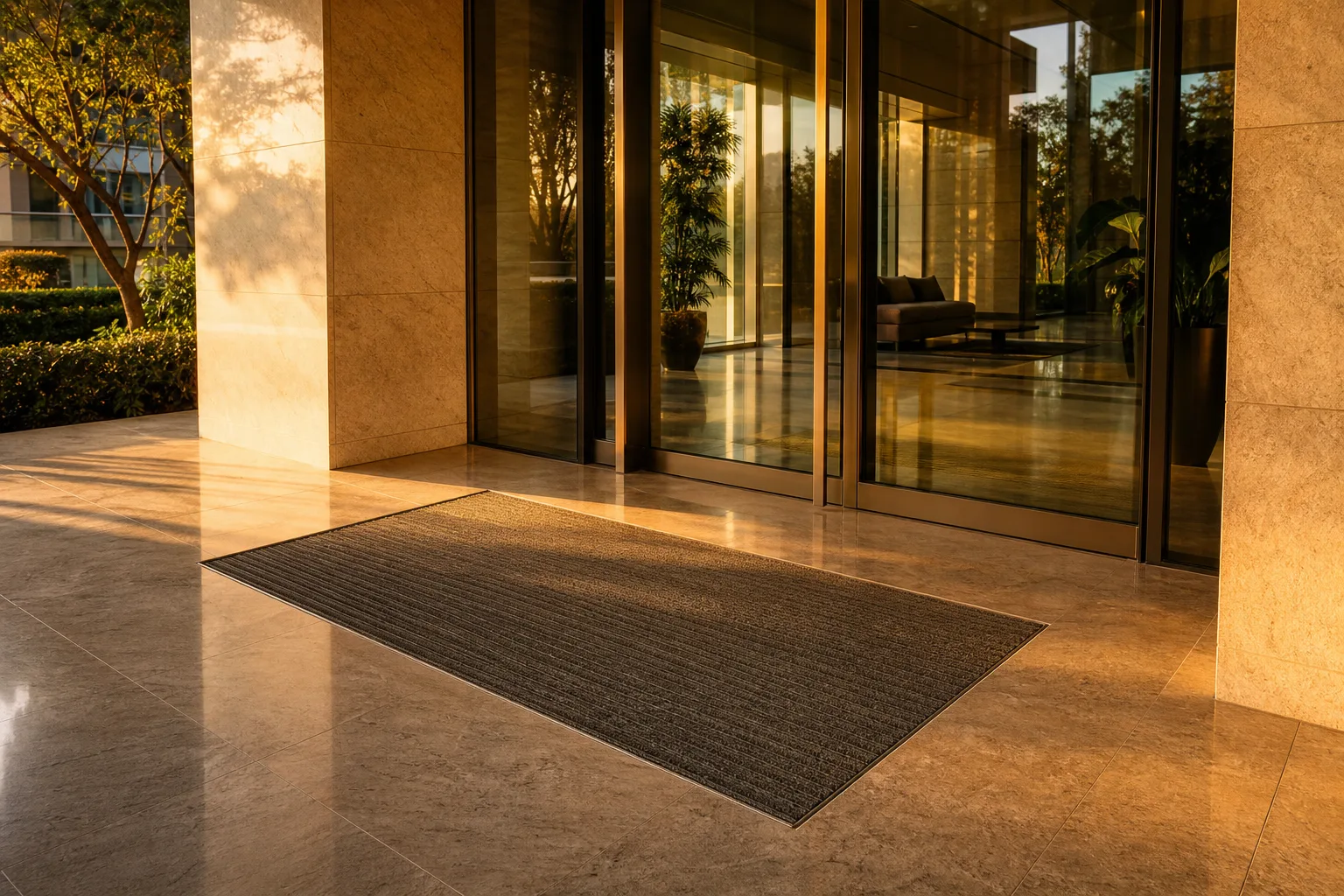
The building got its matting back, in three stages rather than one. An outdoor scraper section with a coarse surface to knock off the heavy debris, a vestibule section to take wet soil, and an interior absorbent run long enough to finish the job. The stone threshold stayed visible, because the interior run was specified as a recessed well mat set flush with the floor instead of a loose mat thrown on top. The cleaning spec changed too: the mats are vacuumed daily and extracted on a schedule, because a saturated mat stops collecting and starts redistributing.
The floor care interval in that building moved back toward its twin's within a year. The elevator calls came down on their own.
At home the same three stages fit inside a few feet. Something coarse outside the door, something absorbent inside it, and enough of the second one that you take two or three steps on it before you reach the floor. Vacuum the inside mat as often as you vacuum anything else, and wash it before it looks like it needs it. Mop with clean water and change it when it turns grey, because grey water lays a film of fine abrasive back down across the whole floor. If shoes come off at the door, you have solved most of it without buying anything.
The reason this advice is worth following is not tidiness. It is that the entry is the one place in a building where soil can be stopped for the price of a mat, and every foot past it the same soil costs more to deal with.