Three quotes on the kitchen table, all for the same house, and the spread between the high and the low is eight thousand dollars. The temptation is to treat that gap as a measure of greed or of quality, depending on your mood. It is usually neither. It is the sum of a dozen small decisions about materials, edges and fasteners, most of which are never written on the page you are handed. And nearly every one of those decisions is governed by a document written by a company that is not in the room and has no contract with you: the manufacturer of the material going on your house.
That third party matters more than most homeowners realize. The shingle maker, the metal panel maker, the underlayment maker: each publishes installation instructions, and each conditions its coverage on those instructions being followed. The instructions are free. They ship in the bundle. They are posted online. Almost nobody outside the trade ever opens one. Here is what to check before you sign, and what changes when the buyer is a household rather than a company replacing forty roofs a year.
1. The lifespan on the wrapper is a laboratory result, not a calendar
A shingle sold as a fifty-year product is not a promise that your roof will be sound in 2076. It is a classification based on standardized testing: weight, tear strength, wind resistance at a stated speed, granule adhesion. Those tests are run on new material under controlled conditions. Your roof will be installed on a July afternoon over decking of unknown age, on a slope with a particular exposure, under trees, above an attic that may or may not move air.
The honest comparison is not fifty years against thirty years. It is cost per year in place, on your house, with your ventilation and your tree cover. An architectural asphalt shingle, a standing seam metal roof and a synthetic slate all occupy different points on that curve, and the one with the longest printed number is not automatically the cheapest over time once you divide by the years you will actually own the house.
Scale changes this calculation outright. A household replacing a roof once or twice in a lifetime is buying a result: no leaks until we sell. A company holding thirty rental properties is buying a replacement interval it can budget against, and will often choose a shorter-rated product on purpose because it can schedule the next one and negotiate volume pricing. Neither is wrong. They are different questions, and a contractor who asks how long you plan to stay before recommending a product is asking the right one.
2. The nailing pattern, which is the single cheapest way to ruin a roof
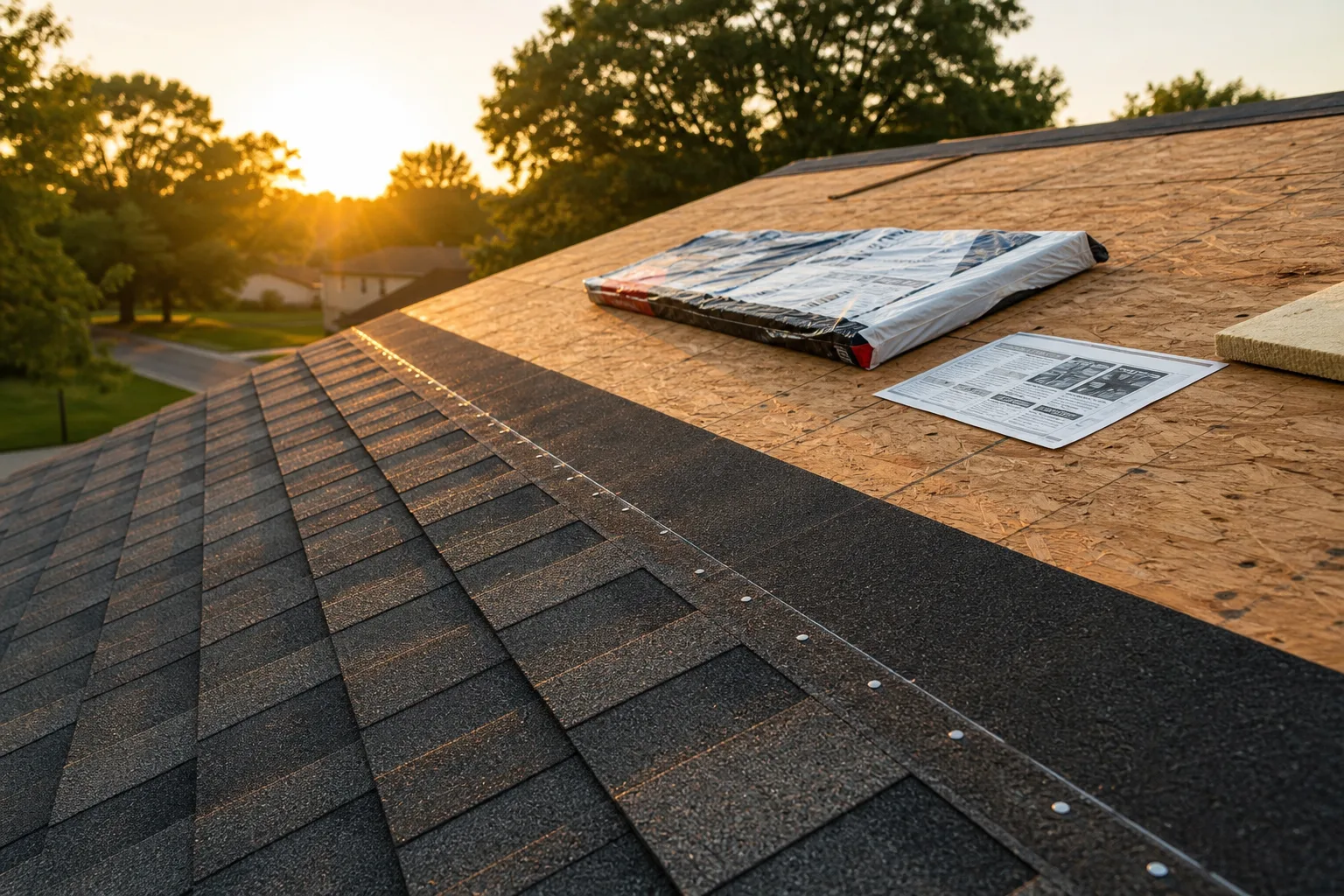
Every asphalt shingle has a nail zone, usually a narrow band marked on the shingle itself, and a specified number of fasteners per shingle that rises in high-wind areas. Nails placed an inch high miss the layer below and hold one shingle instead of two. Nails driven too deep cut the mat. Nails driven at an angle leave a head standing proud that will eventually wear a hole through the shingle above it.
None of this is visible from the ground when the job is done. All of it is visible during the job, for about four hours, if you walk out and look at an open course before the next one goes down. Ask the crew lead how many nails per shingle the instructions call for on your pitch and in your wind zone. The answer should be immediate and specific. If the answer is a number followed by a shrug, that is information.
This is also where the gap between bids often lives. Four nails instead of six across a 30-square roof is a measurable saving in labor and fasteners, and it is the kind of saving that never shows up until a storm arrives. Experienced roofers will tell you the pattern without being prompted, because they have been on the callbacks that follow when someone else skipped a row.
3. What happens at every edge, valley and penetration
Roofs almost never fail in the middle of a field of shingles. They fail where the plane ends or where something comes through it: eaves, rakes, valleys, chimneys, plumbing vents, wall intersections, skylights.
So read the quote for those words specifically. A few questions that separate a thorough scope from a thin one:
- Is drip edge included at eaves and rakes, and is it new? Reusing bent aluminum off the old roof is a real practice and a bad one.
- Is the flashing at the chimney and sidewalls being replaced or reused? Step flashing woven in with the courses is the durable answer. Caulk over old flashing is a two-year answer.
- How far up from the eave does the ice and water membrane run? Codes set a minimum tied to the frost line; good crews go past it on low slopes.
- Are valleys open metal, closed cut, or woven, and does that match what the manufacturer allows for the product being installed?
- Are pipe boots being replaced? The rubber collar on a plumbing vent typically fails long before the shingles do and costs very little to swap while the crew is already up there.
A quote that lists these items by name is not necessarily more expensive. It is more honest about what the job contains, and it gives you something to compare against the bid that just says "tear off and replace, 30-year architectural."
4. Ventilation and decking, the two conditions attached to everything else
Manufacturers condition their coverage on adequate attic ventilation, and they define adequate in square inches of net free area relative to attic floor area, split between intake at the soffits and exhaust at or near the ridge. A ridge vent installed over blocked soffits does not ventilate anything. It just looks like it does.
Heat and moisture trapped under a deck cook the underside of the shingles and shorten the real-world lifespan well ahead of the printed one. If a bid includes a ventilation change, that is usually a sign someone went into the attic. If three bids are silent on ventilation and the fourth raises it, the fourth is not upselling you by default. Ask what they saw.
Decking is the other conditional. Tear-off exposes the sheathing, and some of it will be soft. Every contract should state a per-sheet replacement price agreed in advance, so the number is settled before anyone is standing on your roof with leverage. A company doing volume work has that price standardized across every job. A household gets it by asking for it in writing.
5. Two warranties, two obligors, and the registration nobody files
The material warranty comes from the manufacturer and covers defects in the product. The workmanship warranty comes from the contractor and covers the installation. They are separate instruments with separate backers, and conflating them is the most common misunderstanding in the whole transaction. A thirty-year material warranty paired with a one-year workmanship warranty is a roof backed for one year against the failure mode that is far more likely.
Enhanced system warranties, the ones that cover labor and material together for a long term, generally require three things: a certified installer, a specified set of components from that same manufacturer, and registration of the job within a stated window after completion. Contractors who run volume register as a matter of routine because their certification depends on it. A homeowner dealing with a small crew should ask for the registration confirmation in writing and keep it with the closing documents, along with the transfer terms, since coverage that survives a sale is worth real money at the appraisal. The Federal Trade Commission oversees how consumer product warranties are written and disclosed, which is why the limitations are printed in full rather than summarized on a brochure. Read the limitations section first. It is short, and it tells you what the manufacturer expects of the installer.
The pattern across all five checks is the same. A good job and a barely adequate one use the same brand of shingle, cost the client roughly similar money, and look identical from the curb on day one. What separates them is whether somebody followed the instructions written by a company with no stake in your contract and every stake in its own product lasting. Ask for the installation instructions. A crew that hands them over without hesitating has already told you most of what you wanted to know.