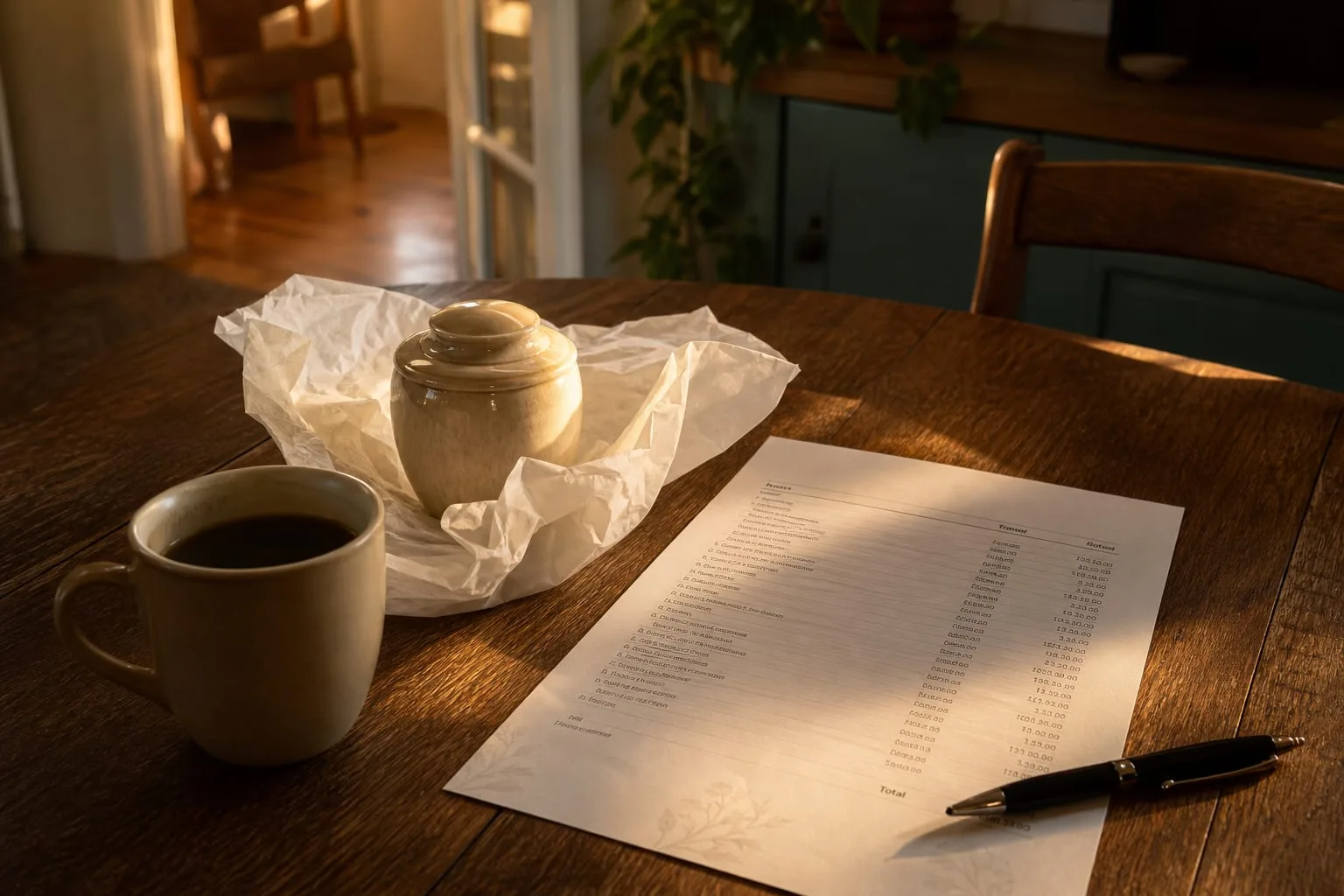
A cremation bill looks like one price. It almost never is. It is a service fee, a transportation charge, a container, a set of filings, a fee paid to a third party who owns the machine, and then a group of items that exist because most families say yes to them without being told they had a choice. Separating those layers is the single most useful hour anyone spends in the week after a death, and it is easier now than it was ten years ago because of how price information is required to move.
The reason it matters is scale. A funeral home handles hundreds of these a year and knows exactly which lines carry margin and which are pass-through. A household does this once or twice in a lifetime, under time pressure, with no basis for comparison. That gap is not anyone's bad faith. It is just the difference between a repeat buyer and a first-time buyer, and it is the gap that costs money.
Start by splitting the bill into three piles
Every itemized funeral statement can be sorted into three groups, and the sorting is more useful than any single number on the page.
The first pile is money the funeral home pays to somebody else and passes to you. Cash advances, in the trade. Death certificate copies, the medical examiner or coroner sign-off where the county requires one, the permit to cremate, newspaper notices, clergy honoraria, the fee charged by the crematory itself if the funeral home does not own one. These barely move on negotiation because the funeral home is not setting them. What can move is the quantity. Certified copies of a death certificate are ordered by the dozen out of habit; the actual number you need is driven by how many institutions demand an original, and that is usually fewer than someone tells you at the counter.
The second pile is the labor and overhead of the establishment. This shows up as a basic services fee, sometimes called a non-declinable fee, and it is exactly what the name says. It covers staff availability, record keeping, coordination with the county and the crematory, and a share of keeping the building open. You cannot decline it, and a provider who breaks it into several smaller mandatory charges is worth a second look. Beyond that fee sit the specific services you actually use: transfer of the body from a residence or hospital, refrigeration or holding time, a witnessed cremation, staff at a service.
The third pile is merchandise. A cremation container or casket, the urn, register books, printed folders, an outer burial container if anything is going into the ground. This is the pile with the most room in it, and the one where the decisions are most reversible if you slow down by a day.
What changed, and why it lands on your kitchen table
Two things shifted at once. Cremation went from a minority choice to the common one across most of the country, and pricing information stopped being something you could only get by driving to a building.
The Federal Trade Commission is responsible for the rule that requires funeral providers to give you an itemized price list and to let you buy only the goods and services you want. That obligation has been in place for a long time. What changed recently is the practical reach of it. Providers increasingly post those lists on their own websites, state associations and consumer groups compile them, and families arrive already knowing that the number quoted on the phone is a package built from parts. A package is not a trick. It is a bundle, and bundles are sometimes cheaper. But you cannot tell whether a bundle is cheap without the parts list, and the parts list is now something you can read on a phone at two in the morning.
The second change is that merchandise stopped being a captive market. A provider must accept a container you obtained elsewhere and may not charge you a handling fee for it. That has been true on paper for years; what is different is that ordinary families now act on it, because ordering an urn from an outside supplier has become as routine as ordering anything else. Comparison shopping cremation urns from a specialist retailer instead of the display case is now the ordinary path rather than the unusual one, and the price spread between the two is often the largest single variance on the whole statement.
The consequences nobody traces back
Here is where the everyday effects show up, months later, with no obvious connection to the funeral home.
Families buy an urn sized for a display shelf and then decide, a year on, to divide ashes among three siblings or place a portion at a cemetery. Now they are buying again: keepsakes, a second vessel, sometimes a niche container that must meet a cemetery's dimensional rules. Deciding the destination first and the container second saves that repeat purchase, and the destination question is free to ask.
Families pay for holding time they did not know was accruing. Refrigeration or storage is often billed daily. A delay while relatives arrange flights is a real and human reason to wait, but it has a meter on it, and nobody volunteers that at signing.
Families accept a rental casket or a ceremonial container for a viewing without asking what the alternative looks like. Sometimes the viewing matters enough to justify it. Sometimes the family wanted twenty minutes in a private room and would have been content with far less.
And families buy printed goods in quantities set by a template. Folders, prayer cards, acknowledgment stationery. Small individually. Not small together.
How to run the conversation without becoming an adversary
Ask for the itemized list on paper before any total is discussed, and take it into another room. Circle every line and put a P, an S, or an M next to it: pass-through, service, merchandise. Ask two questions about each pass-through line: who is actually paid, and how many do we need. Ask one question about each service line: what happens if we skip it. Leave merchandise for last, and give yourself twenty-four hours on the urn if the schedule allows it, because that is the item with the widest range and the least urgency.
Then compare against one other provider's list. Not to threaten anyone with it. Just to know whether the basic services fee in front of you sits in the middle of the local range or at the top, because that one figure explains more of the difference between two quotes than everything else combined.
The bill that arrives after all of this tends to be smaller, but the more durable result is that the family understands what they bought. That understanding is what keeps the second and third purchases from happening, and it is why the hour spent sorting the list pays for itself twice.