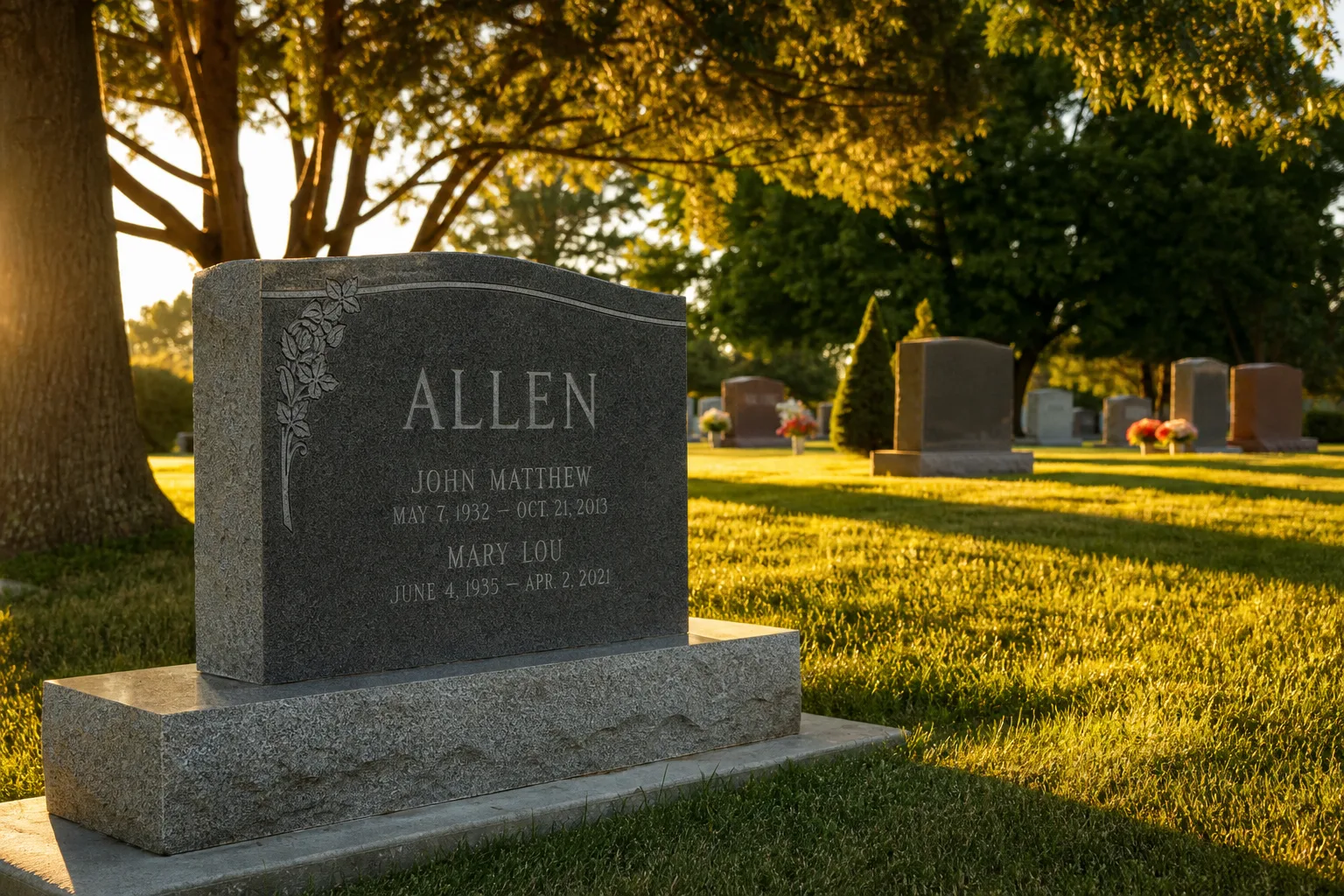
The first week after a death runs on a fixed order whether anyone announces it or not. Paperwork comes before a provider. A provider comes before a cemetery. The cemetery comes before the memorial, always, and families who reverse those last two spend money twice. Most of what goes wrong is not a bad decision. It is a decision made out of sequence, when the information that would have changed it had not arrived yet.
The useful way to judge any of it is to ask how the arrangement looks in year eight. Not at the service. At year eight, when the lawn crew has mowed around the marker three hundred times, when a frost cycle has lifted and dropped the foundation eight winters running, and when nobody involved in the original week is still answering the phone at the funeral home.
Days one and two: authority to sign, and how many certified copies
Nothing moves until someone with legal authority signs. Who that is varies by state. Many states set an order of priority: a surviving spouse, then adult children, then parents, then siblings. Some states recognize a written designation of an agent for disposition, a document signed in advance naming the person who decides. If the deceased left one, it generally governs, and it will save an afternoon of phone calls among relatives who each believe they are next in line.
The death certificate is the spine of everything that follows. A physician or medical examiner certifies the cause, the funeral provider files it with the local registrar, and the registrar issues certified copies. Filing deadlines are set at the state level and are short, usually a matter of days. The barely adequate version of this step is ordering three copies because someone suggested three. The good version is counting the institutions first: each life insurance policy, each bank and brokerage account, the pension or annuity, the vehicle title at the DMV, the county recorder if real property transfers, Social Security. Ordering additional copies later costs more per copy and takes weeks. Order more than you think you need in week one.
A practical note on regional difference: in some counties the registrar is a separate office from vital records at the state level, and the turnaround times are not the same. Ask the funeral director which one they file with and how long that office is currently taking. They file there weekly and will know.
Day two to four: comparing providers, and what the price list is obligated to show
Three routes are open to most families. A full-service funeral home handles transfer, preparation, viewing, service, and cemetery coordination as a package. A direct cremation or direct burial provider handles transfer, the minimum paperwork, and nothing else, leaving the service to a family, a church, or a later date. In a smaller number of states, a family may conduct a home funeral and file the paperwork themselves, though several states require a licensed funeral director to sign or file certain documents, which makes the fully independent route unavailable in those places.
The Federal Trade Commission is responsible for the rule that governs how funeral providers disclose their prices. In practice this means you are entitled to an itemized list of goods and services, in writing, before you agree to anything, and you may decline items you do not want. A provider who hands you the itemized list without being asked, and who marks which items are required by the cemetery rather than by the funeral home, is doing the job well. A provider who quotes one package number and resists breaking it apart is doing the minimum.
The thing to carry into this conversation: the funeral home's price list and the cemetery's price list are two separate documents from two separate businesses, even when the funeral home offers to handle both. Opening a vault, setting a foundation, and recording the interment are cemetery charges. Ask to see them separately.
Day three to five: the cemetery, which settles more than the catalog does
This is the step where the week's decisions stop being reversible. What you buy at a cemetery is not land. It is interment rights, the right to be buried in a specific space under that cemetery's rules, and those rules change over time at the cemetery's discretion. Read them before the deed is signed, not after.
Rules vary by region in ways that surprise people who have arranged a funeral in another state. Cold-climate cemeteries commonly stop setting foundations once the ground freezes, which means a burial in November may not receive its marker until the following spring. Many cemeteries require an outer burial container, a concrete or polymer vault around the casket, because without one the ground settles and the lawn develops hollows. That requirement is almost always the cemetery's, not the funeral home's, and in some states a provider must tell you so in writing. Municipal and county-run cemeteries often have tighter, simpler rules than private ones, and some older churchyards and rural family cemeteries have no written rules at all, which is its own problem when a question arises two decades later.
The section matters as much as the cemetery. A lawn section may permit only flush markers set level with the turf. A monument section permits upright stones. Some sections cap the height, the footprint, or the material. Before anyone looks at a catalog of grave headstones, get the section's specification sheet in writing, because it determines which half of the catalog is even available to you.
Week one versus later: what to decide now, and what improves if you wait
A few things genuinely have to happen inside seven days. The paperwork. The provider. The disposition. The cemetery space, if the burial is immediate. The obituary, if there is one, because newspapers and online notices run on their own deadlines.
The memorial is not one of them. Granite markers are cut, carved, and shipped on a schedule measured in weeks or months, and the foundation has to cure or the ground has to settle before setting. Nothing is lost by deciding the inscription in month two with a clear head. Quite a lot is lost by approving a proof in week one while running on four hours of sleep.
Judged by how it looks in year eight, the differences between options are material and they are specific:
- Granite versus marble. Marble carves beautifully and loses detail to acid rain and freeze-thaw over decades. Granite is harder, holds a polished face, and keeps lettering legible far longer. In regions with hard winters and road salt nearby, that gap widens.
- Bronze on a granite base versus bronze on concrete. Bronze develops a patina either way. The failure that shows up later is the base: concrete spalls and cracks at the edges after repeated freezing, and the plaque ends up sitting on a crumbling border. A granite base costs more once and does not do that.
- Flush markers and mowers. A flush marker set slightly proud of the turf takes mower blade strikes on its edges for years. Set correctly, level and on a proper foundation, it does not. Ask how deep the foundation goes and what it is poured on. In clay soils that heave, that answer is the difference between a level stone and a tilted one.
- Lettering. Sandblasted and recessed lettering survives. Painted or filled lettering needs refreshing on a cycle. Neither is wrong, but one is a maintenance commitment and the person making the choice should know which they picked.
Ask one more question of the cemetery while you are there: who is responsible for resetting a marker that settles, and is there a care fund that pays for it. Cemeteries with a perpetual care fund, which many states require and regulate, have a mechanism for that work. Knowing the answer in week one tells you what you are buying.
The families who come through this well are not the ones who made faster decisions. They are the ones who separated the irreversible from the merely urgent, handled the paperwork and the cemetery rules in the first few days, and gave the marker the time it needs to be ordered properly. The order of operations is doing most of the work.