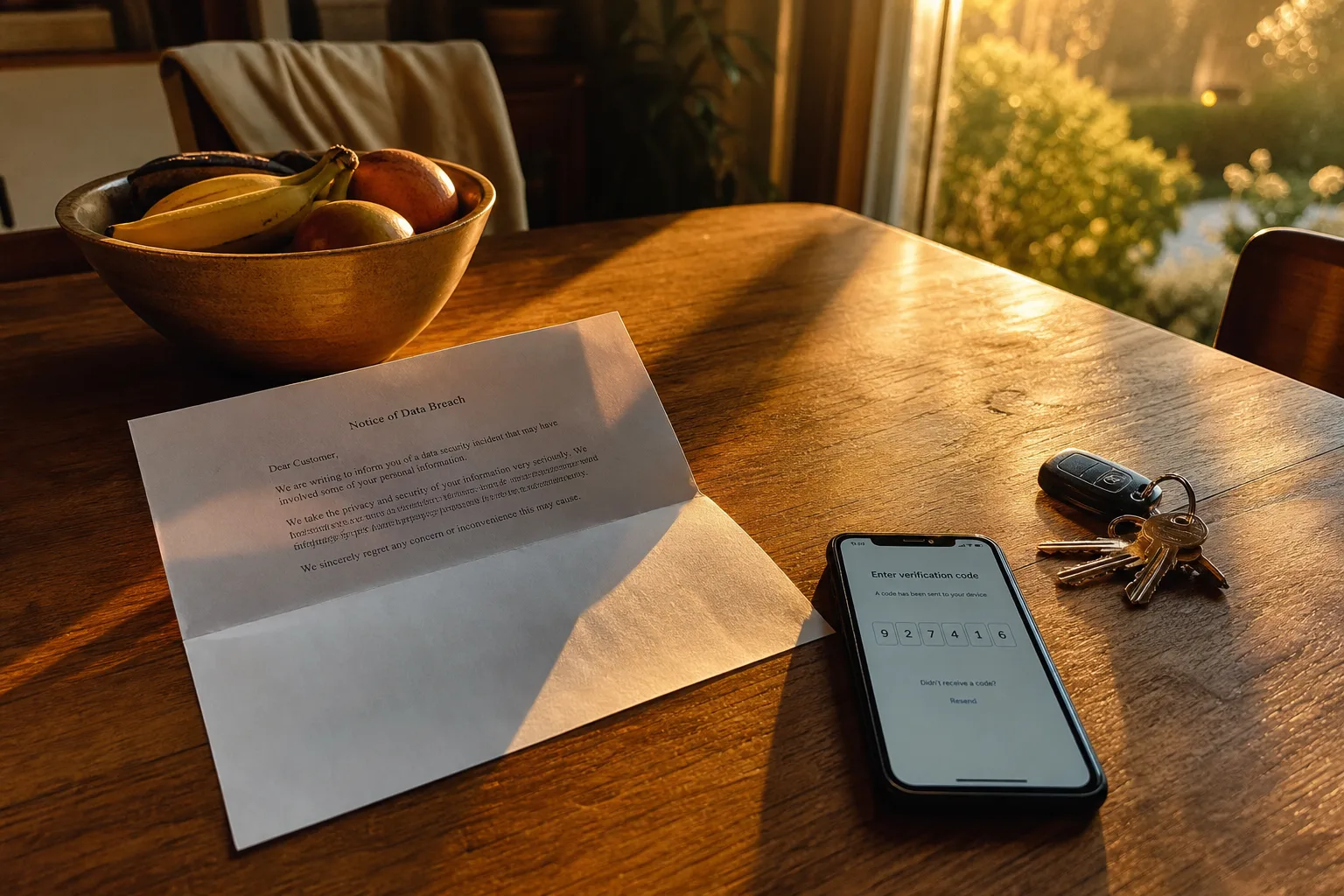
The letter arrives, you skim it, and nothing happens. No charge appears. No account empties. Six weeks later your mortgage application stalls on an identity check, or your cell carrier will not let you add a line over the phone, or your tax return comes back rejected because one has already been filed under your Social Security number. Almost nobody connects those two events. They are the same event, separated by time and by a third party who was never part of the original transaction at all.
That third party is the point. When people picture a breach they picture two parties: the company that lost the data and the thief who took it. The party that actually determines what the loss costs you is the next organization that has to decide whether a person contacting them is really you. The bank. The wireless carrier. The pharmacy. The utility. The county clerk. None of them lost anything. All of them are now working with worse information than they had last month.
What leaves in a breach is a set of answers
Most American institutions verify identity by asking questions only the right person should be able to answer. The industry term is knowledge-based authentication, and it means exactly what it sounds like: you prove you are you by knowing things. Your date of birth. The last four of your Social. The street you lived on in 2014. Your mother's maiden name. The amount of your monthly auto payment.
Those questions work on one assumption, which is that the answers are scarce. A breach is the event that makes them abundant. A file containing names, birthdates, addresses, account numbers, and prior addresses is not valuable because it unlocks the breached company. That company has usually already forced a password reset. It is valuable because it is an answer key for every other institution that still asks those questions.
So the damage does not stay with the company that sent the letter. It spreads outward to every verifier who relies on the same facts. That is why a breach at a hotel chain or a payroll processor can surface months later as a problem with a lender you have banked with for twenty years. The lender did nothing wrong. Its questions simply got easier for a stranger to answer.
The consequences people never trace back
The direct losses are the ones that get discussed and, in practice, the ones most often reversed. Fraudulent card charges get disputed. The indirect consequences are smaller, stranger, and much harder to connect to a cause.
- A phone line that goes dead mid-afternoon. Someone with your personal details convinced a carrier to move your number to a new device. Every text-message code you receive now goes to them first.
- A loan or lease that slows down for no visible reason. The underwriter pulled a report with a credit freeze or a fraud alert on it, or with a new inquiry nobody can explain, and the file goes to manual review.
- A tax return rejected as a duplicate. A filing has already gone in under your Social Security number, which means refunds wait while the matter is sorted out.
- A utility deposit you have never been asked for before. The account scoring picked up something unfamiliar in your file.
- A pharmacy or insurer that will not discuss your account by phone. Their fraud rules tightened after a wave of attempts, and your verification answers no longer clear the bar.
Each of these is a verifier reacting, correctly, to a world where your details are no longer private. The friction is the system doing its job. The way to reduce it is not to argue with the verifier but to give that verifier something better to work with than questions.
Replace knowledge with a control you hold
Once you see the mechanism, the advice stops being a list and becomes a single idea: wherever an institution currently verifies you by what you know, swap in something you hold or something you switched on. Knowledge is what the breach took. Control is what it could not.
Freeze your credit at all three nationwide reporting agencies. A freeze is free, it is reversible in minutes, and it stops a lender from opening a new account in your name even if the applicant answers every question perfectly. The Federal Trade Commission oversees identity theft reporting and recovery for consumers and is the right starting point for understanding your rights here.
Ask the IRS for an Identity Protection PIN. It is a six-digit number that changes annually, and without it a return filed under your Social Security number will not be accepted. That turns a knowledge check into a possession check.
Call your wireless carrier and add a port-out PIN or number lock, which is a separate thing from your account password. Then move your important logins off text-message codes and onto an authenticator app or a hardware key, so that losing the phone number stops being the same as losing the accounts.
Where a site lets you set custom security questions, set answers that are not true. The answer to your first car can be a random string stored in your password manager. A false answer is invulnerable to a data breach by definition, because it exists nowhere in the records anyone could steal.
Keep the letter, and date it
The notice itself has an afterlife. If a dispute arises later, a written record that your data was exposed on a particular date by a particular company does real work: it supports a fraud claim, it establishes you were not careless, and it sometimes qualifies you for monitoring or compensation you would otherwise miss. Scan it, file it with your tax documents, and note the date it arrived.
The people most likely to come out of a breach unharmed are rarely the ones who read the letter most carefully. They are the ones who spent an hour afterward changing how the next institution will check them. That hour is cheap, it is portable across every verifier you will ever deal with, and it holds up the next time a letter lands.