The person who sells you a memorial almost never makes it. That is not a criticism of the trade, it is how the work is organized, and it explains most of what confuses families about pricing, lead times and the handful of choices that cannot be taken back. A single grave marker typically passes through four sets of hands before it stands upright in a cemetery: a quarry, a fabricating and engraving shop, a cemetery grounds operation, and whoever pours or sets the foundation. Each one has its own constraints. Each one has had those constraints change in the last decade or two. If you understand what each is solving for, the advice you get from the showroom stops sounding arbitrary.
The quarry decides the color, and the color decides more than looks
Granite is not made to order. It is cut out of a hole in the ground in blocks, and the color you can buy is whatever comes out of that hole. Vermont and Georgia have long supplied grays. A great deal of the red, mahogany, blue-black and speckled stone in an American cemetery came out of India or China, was rough-sawn near the quarry, and shipped as slab or a finished blank.
What changed is the supply chain rather than the rock. Shipping costs and lead times on imported stone have swung hard enough in recent years that shops now quote color availability the way a builder quotes lumber: this one is here, this one is eleven weeks out. A dealer steering you toward a domestic gray in October is often not upselling. They are telling you which stone can actually be set before the ground freezes.
Color also sets what kind of lettering will read. Dark, deeply polished stone shows a laser-etched portrait beautifully because the laser removes the polish and leaves a gray image behind. That same effect is nearly invisible on a light speckled granite, where sandblasted letters filled with paint carry the reading instead. So the color choice quietly makes the lettering choice. Once the blank is cut and shipped, that is settled.
The engraving shop's hands moved to a computer, and the proof became the decision point
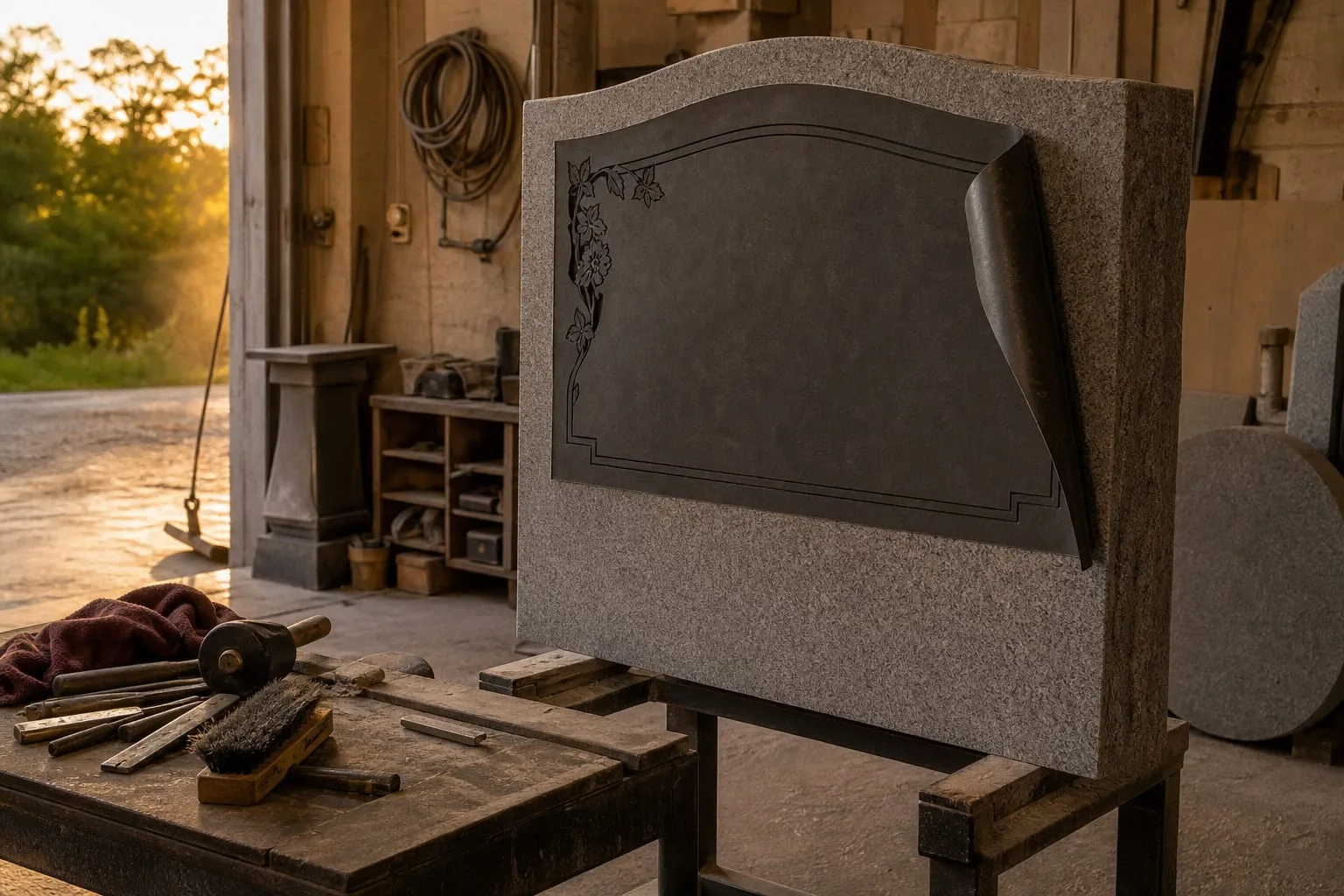
Traditional monument lettering is sandblasted. A rubber stencil is stuck to the face of the stone, the letters are cut out of the stencil, and abrasive under pressure eats away the exposed granite. What used to be cut by hand with a knife is now cut by a computer-driven plotter from a digital layout file, and the shape of the stone itself is often cut on a CNC saw rather than by a person walking a blade through it.
This is why the proof matters so much more than it used to. In the old shop, a layout artist held the design in their head and on paper, and a foreman looked at the stone before the blast. Today the file is the design. It goes to the plotter, the plotter cuts exactly what is in it, and nobody in the chain after that reads the name for sense. A transposed middle initial, a 1953 that should be 1935, a maiden name spelled the way the family says it rather than the way the vital record has it: all of it survives to the finished stone if it survived the proof.
Practical consequences worth acting on:
- Get the proof as a file you can enlarge, not a thumbnail in an email chain. Read the dates digit by digit, out loud.
- Check the death certificate against the proof rather than checking the proof against your memory.
- Have a second person who was not in the showroom read it cold.
- Ask where the second name and date will sit if a spouse is to be added later, and whether the layout leaves usable room.
That last one is the most commonly regretted. Adding a date to a stone already standing is ordinary work. Adding it to a face that was centered as though only one person would ever appear there is not.
The grounds crew writes rules that read like aesthetics and are really about mowing
Cemetery regulations on marker type, height and setback look like taste. Mostly they are maintenance math. A crew running wide riding mowers across several hundred acres cannot stop and hand-trim around raised stones without adding labor the endowment does not fund. That is the reason so many newer sections permit only flush bronze or granite markers set level with the turf, while the older sections a hundred yards away are full of uprights.
The recent change here is consolidation and staffing. Grounds work has gotten harder to hire for, and many cemeteries have narrowed what they permit rather than expand the crew. Some have moved to a short approved list by section. Some now require that any foundation be poured by the cemetery's own crew, at the cemetery's rate, because a marker that settles crooked becomes their problem for the next eighty years.
None of this is hidden. It is written down, and the cemetery office will hand it to you. But it comes from a different organization than the one selling you the stone, and the two do not always talk. Ask for the section rules in writing before you approve a size, because a permitted 36-inch die in one section can be a rejected one two rows over.
The foundation setter controls the calendar, and the calendar is not negotiable
A memorial does not sit on dirt. It sits on a concrete foundation, poured to a depth that gets below the local frost line so that seasonal freeze and thaw cannot heave it. In the northern half of the country that depth is real, and it means foundation work stops when the ground freezes and resumes in spring. A stone finished in December may wait until April to be set. Families who were not told this in the showroom experience it as a broken promise, when it is really a concrete cure and a frost depth.
Bronze runs on its own clock. A cast bronze plaque is made in a foundry from a pattern, and foundry lead times move with metal prices and order volume. When bronze is expensive, some cemeteries and dealers have shifted their standard flush marker to granite, which is why a family comparing a relative's 2010 marker to today's options sometimes finds the material itself has changed.
The Federal Trade Commission is responsible for the federal rules governing how funeral goods and services are priced and disclosed, and the habit those rules built, itemized paper you can take home and compare, is exactly the habit to carry into the monument purchase. Ask for the stone, the engraving, the foundation and the setting fee as separate lines. The foundation and setting are frequently a cemetery charge rather than a dealer charge, and seeing them apart tells you who to call when the date slips.
What to nail down before anyone starts cutting
Four questions, one for each trade. Which stone colors are actually available on your timeline, and which lettering method suits the one you pick. What exactly does the proof say, verified against the death certificate. What does this specific cemetery section permit, in writing. Who pours the foundation, at what price, and in which month.
Answer those and the reversible decisions stay reversible. A layout can be revised any number of times before the stencil is cut. A color can be swapped before the blank ships. What cannot be undone is a blasted misspelling, a crowded face with no room for the second date, and a size the section will not accept. Those are the four conversations worth slowing down for, and slowing down costs nothing but a week.