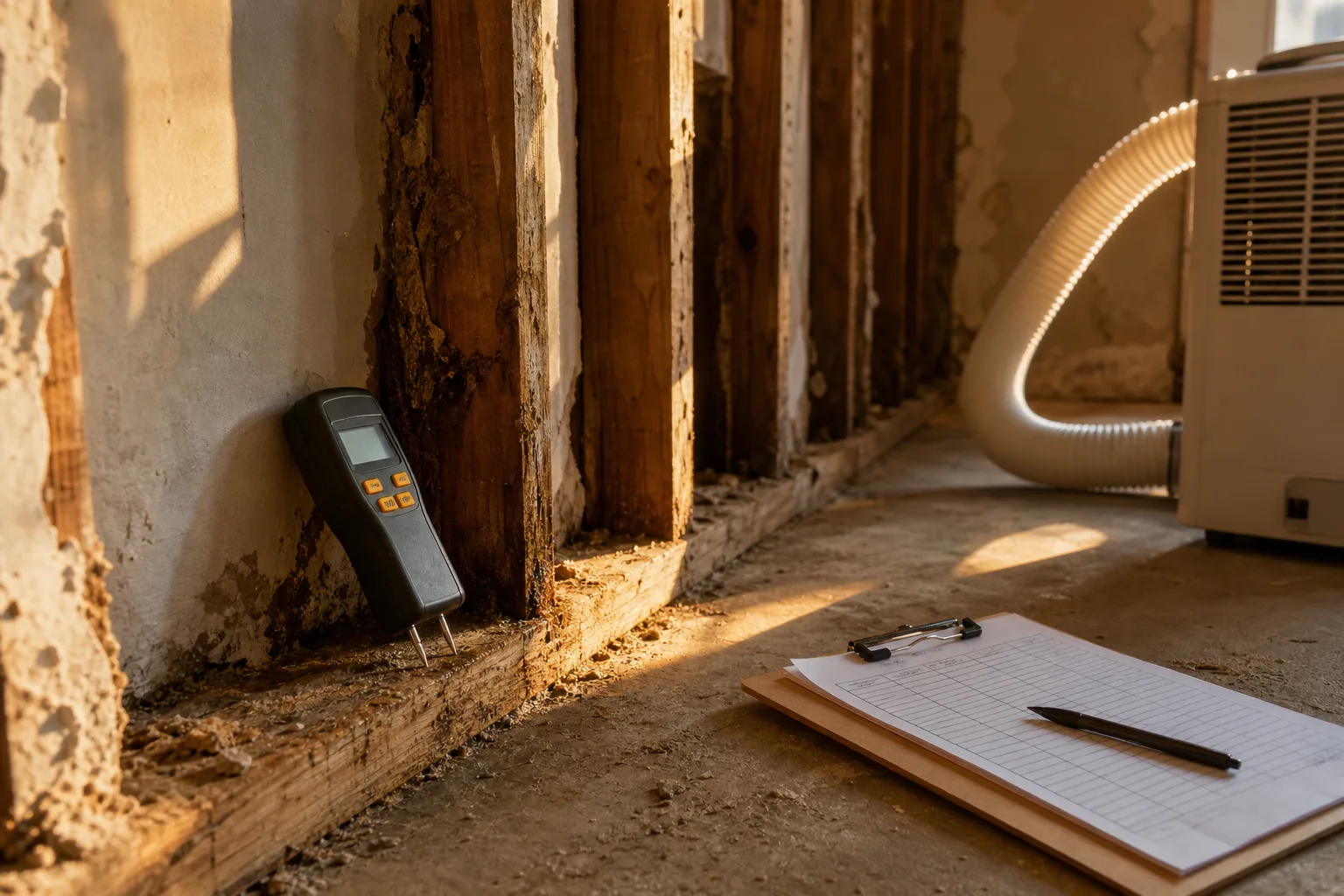
The second or third time you stand in a house with air movers running, you stop watching the fans and start watching the numbers. The fans are the cheap part of the job. The expensive part is deciding when to shut them off, and the only honest way to decide that is to have written down, every day, what the materials and the air were doing. Crews that dry buildings for a living are not faster because they own better equipment. They are faster because they know what the building is going to do next, and they have the paperwork to show they were right.
Water leaves a wall in three stages, and only one of them is quick
Wet drywall, wet framing and wet subfloor do not release water at a steady rate. There is free water sitting in the pores and cavities, which moves easily. There is capillary water held in the small spaces of the material, which moves more slowly. And there is bound water, chemically attached to the fibers themselves, which comes out last and comes out grudgingly.
That is why a drying job looks like a success on day one and stalls on day two. The free water goes fast. Surfaces feel dry. Carpet looks fine. Then the curve flattens, because what is left is the water that has to migrate out of the depth of the material before it can evaporate at all. A pin meter pushed into the bottom plate of a wall will often read higher on day three than the drywall face above it did on day one, not because the wall got wetter but because you finally measured the part that mattered.
Evaporation itself is driven by a difference in vapor pressure between the wet material and the air touching it. Dry the air and that difference widens, so water leaves faster. Move the air across the surface and you strip away the thin saturated layer that otherwise sits there and stalls the exchange. Warm the space and both the material and the air hold and release water more readily. That is the entire mechanism: dry air, moving air, warm enough air. Everything in the equipment trailer exists to produce one of those three conditions.
Knowing the mechanism makes the advice obvious. If the air in the room is already loaded with moisture, adding another fan accomplishes very little, because the air has nowhere to put the water. If the room is cold, the dehumidifier runs at a fraction of its rated capacity. A crew that understands this will add a dehumidifier before adding a fourth air mover, and will stop opening windows in humid weather no matter how much it feels like ventilation should help.
The instruments that turn a judgment call into a reading
Four tools do almost all of the work, and each answers a different question.
A pinless moisture meter reads a short distance into a material without marking it. It is the scanning tool. You walk a wall with it to find where the water went, which is usually further than anyone expects, because water follows gravity and then wicks sideways along the bottom plate.
A pin meter puts two probes into the material and measures resistance between them. It gives you a defensible number for one specific spot at one specific depth. This is the tool that ends arguments, because the same spot can be measured the same way tomorrow.
A thermo-hygrometer reads temperature and relative humidity, which together let you calculate how much water the air is actually carrying. Restoration work usually expresses that as grains per pound, often shortened to GPP: the weight of water vapor in a pound of dry air. Relative humidity on its own is misleading because it moves when the temperature moves. Grains per pound does not. Two rooms can both read sixty percent relative humidity and hold very different amounts of water.
An infrared camera shows surface temperature differences, which often correspond to wet areas because evaporation cools a surface. It is a pointing device, not a moisture meter. It tells you where to put the pins. Treated as proof on its own it will mislead you, and anyone who has done this many times has had a cold spot turn out to be a missing piece of insulation.
The reading that actually governs the job is the gap between the air coming out of the dehumidifier and the air going in, measured in grains per pound. That gap is called grain depression, and it tells you whether the machine is still pulling meaningful water out of the room. When it narrows to almost nothing, either the room is dry or the machine is undersized, overwhelmed or placed badly. Either way, the number tells you something is wrong before the calendar does.
The dry standard, and why it has to be set on day one
You cannot declare something dry without a target, and the target is not a universal number. Wood in a coastal house in August sits at a different moisture content than the same wood in a dry inland winter. So the first morning's work includes finding an unaffected area of the same material in the same building and measuring it. That reading becomes the dry standard: the number the wet material has to come back to.
Set it on day one or you will never get it. Once the dehumidifiers have been running for seventy-two hours, the whole building has shifted and there is no honest baseline left to find. Experienced crews take those readings before they plug anything in, and they take them in writing.
The Environmental Protection Agency is the federal body responsible for guidance on indoor moisture and mold in buildings, and its framing is worth holding onto: the problem is not the water event, it is how long materials stay wet afterward. That is the entire argument for measuring rather than guessing. A building dried to a documented standard in four days is in better condition than one that was blasted with fans for two days and assumed dry.
The log, the moisture map and the invoice they produce
Three documents carry a drying job. They are unglamorous and they are the difference between a clean file and a fight.
The moisture map is a sketch of the affected area with numbered monitoring points marked on it. Point four is point four every day. Without the map, one technician measures the bottom plate and the next measures two feet up the drywall, and the readings look like the wall is getting wetter.
The daily drying log records, for each visit: outside temperature and humidity, conditions in the affected area, conditions in an unaffected area for comparison, the dehumidifier's intake and discharge readings, and the material readings at every mapped point. It also records what equipment was moved, added or removed and why.
The equipment record lists each machine, where it sat and the hours it ran. This is the document that supports the line items on the bill, because drying equipment is almost always billed per unit per day.
Those three documents do four jobs at once. They show the trend, which is the only thing that tells you whether the plan is working. They justify changes in writing at the moment they are made. They support the invoice against an adjuster who asks why six air movers ran for five days. And they give the homeowner a record that the structure reached a documented standard, which matters years later if anyone asks what happened in that wall.
What a flat line on day three is telling you
When readings stop falling, the materials have not stopped drying out of stubbornness. Something is blocking one of the three conditions. The common causes are familiar to anyone who has worked enough losses: trapped water behind a vapor barrier or vinyl wallpaper, insulation holding moisture inside a cavity, a cold space where the dehumidifier cannot perform, or a tile floor with water underneath and nowhere to go.
The fix is almost never more fans. It is drilling the bottom plate and injecting dry air into the cavity, removing the material that is trapping the water, adding heat, or moving to a different class of dehumidifier. The flat line is useful information, which is precisely why it is worth having a log to see it in.
The last reading on the last day is the one that closes the job, and it should match the dry standard set on the first. That is the whole discipline in one sentence: decide what dry means before you start, then prove you got there.