The order matters more than most people expect. In the first week after a death, decisions arrive in a sequence set partly by the body, partly by county paperwork, and partly by a set of federal disclosure rules that exist because families in this situation almost never shop around. Understanding why each step lands when it does makes the comparison between your options much easier, because you stop treating it as one giant purchase and start seeing it as four or five smaller ones, each with its own protection attached.
The first phone call, and the price question you can ask on it
Somebody has to be called to take the body. That call usually happens within hours, and it feels like the moment everything gets decided. It isn't. Transferring a body into a funeral home's care and choosing what happens afterward are separate transactions, and they are priced separately.
The reason this matters is a rule the Federal Trade Commission is responsible for enforcing, commonly called the Funeral Rule. It governs how funeral providers quote prices, and one of its plainest requirements is that you can get prices over the telephone. You do not have to drive over. You do not have to give your name. If you call three funeral homes at eleven at night and ask what a direct cremation costs, or what the basic services fee is, each one is expected to answer.
So the practical move on day one is narrow: arrange the transfer and removal, ask for the phone price on the two or three items you already know you want, and hold everything else. Nothing about a transfer obligates you to buy a casket, a viewing, or a service from that same provider, though staying with one provider is usually simpler and often cheaper once you count transfer fees a second time.
Why an itemized list arrives before the conversation
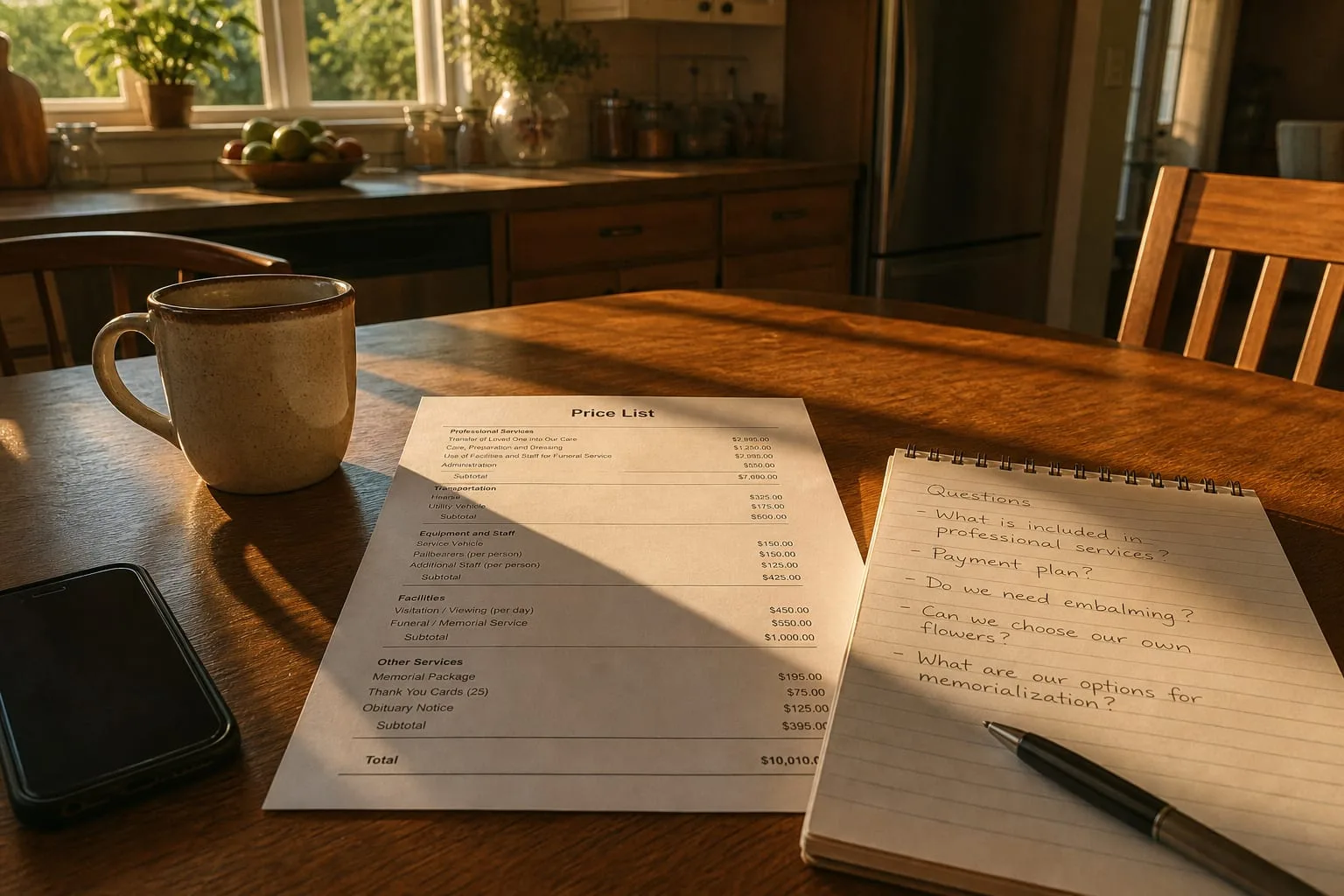
When you sit down in person, a printed general price list should be handed to you at the start, before anyone talks you through packages. That sequence is deliberate. A list handed over after a conversation is a receipt. A list handed over before it is a menu.
Read it for structure, not for the total. Two things sit inside it that shape every later choice:
- The basic services fee. This is the one charge a provider may add to every arrangement regardless of what else you pick. It covers staff time, planning, permits, sheltering the body, coordination with the cemetery or crematory. You cannot decline it, and comparing it across providers is the single fastest way to see how two homes really differ on price.
- Everything else, priced one line at a time. Embalming, use of the chapel, a hearse, staff for a graveside service, a printed register book. Each has to appear on its own, with its own number, so that a package can be taken apart and checked against the sum of its parts.
If you look at caskets or urns, a separate list applies to those, and it should reach you before you walk into the selection room rather than after you have stood in front of the display. There is also a rule against requiring you to buy any item as a condition of buying another, with a narrow set of exceptions the provider has to be able to point to.
Three routes through the same week
By day two or three you are choosing between roughly three shapes. They differ less in dignity than in how many separate vendors and deadlines they involve.
| Route | What drives the timing | Where the choices cluster |
|---|---|---|
| Burial with a viewing | Preservation of the body, cemetery opening schedule, clergy availability | Embalming or refrigeration, casket, outer burial container, plot and opening fee, headstone later |
| Direct cremation | Authorization signatures and the required waiting period in your state | Container for cremation, urn, whether any gathering happens at all, and when |
| Cremation with a service first, or a memorial afterward | Family travel, not the body | Rental casket or alternative container, venue, timing weeks out if you want it |
The third route is the one most people don't realize is available in week one. Cremation decouples the gathering from the body, which means the memorial can happen when relatives can actually fly in. It also means the expensive week and the emotional week do not have to be the same week.
On embalming, the rule is worth knowing precisely because it is so often assumed away: no state law requires it in ordinary circumstances, a provider generally may not charge for it without permission, and refrigeration is usually an accepted alternative for a short delay. If a viewing is planned across several days, embalming is the practical answer. If it isn't, the question should still be asked out loud rather than absorbed into a package.
What you are allowed to bring yourself
A funeral home has to accept a casket or urn you bought elsewhere, and it may not charge you a handling fee for doing so. This is one of the clearest customer-side protections in the whole set, and it exists because the casket is where the widest price spread sits. Online and third-party sellers ship to funeral homes routinely.
Two cautions, both about logistics rather than permission. Delivery has to land before the service, and week-one timelines are tight, so confirm the arrival date in writing before you commit. And cemeteries, unlike funeral homes, set their own requirements for what goes in the ground, which is a separate rulebook from the one above.
The paperwork that decides everything else
Running underneath all of it is a document chain: pronouncement of death, the death certificate signed by a physician or medical examiner, a disposition permit from the local registrar, and cremation authorization if that is the route. Certified copies of the death certificate are what banks, insurers, and the DMV will want, and they typically take days rather than hours to come back.
Order more copies than you think you need, in the first week, while a funeral director is already filing on your behalf. Ordering them later means doing it yourself through vital records at a slower pace.
Before any of this is signed, you are owed one more thing: an itemized written statement listing everything you selected and the total. Read it against the price list you were handed at the start. Those two pieces of paper are designed to match, and when they do, you can stop thinking about money and spend the rest of the week on the part that actually matters.